



Table of Contents
A square and a cube Class 8 worksheet with answers gives students a ready set of questions on perfect squares, perfect cubes, and their roots — exactly the topic covered in NCERT’s Ganita Prakash Class 8, Chapter 1, “A Square and a Cube.” This post gives you a full concept recap, a 25-question printable worksheet, and fully worked answers, so you can practise and self-check in one sitting, whether you follow CBSE, ICSE, IB, or a State Board syllabus.
What Is “A Square and a Cube” in Class 8 Maths?
“A Square and a Cube” is the Class 8 Maths topic that teaches how to square a number, cube a number, and reverse the process using square roots and cube roots. In the latest NCERT Ganita Prakash textbook it is Chapter 1; in the older NCERT edition (still followed by many CBSE and State Board schools) the same ideas appear as two separate chapters — “Squares and Square Roots” and “Cubes and Cube Roots.” ICSE and IB schools cover near-identical concepts under their own chapter names, so this worksheet works across boards.
- Square of a number: multiply a number by itself once (a × a = a²).
- Cube of a number: multiply a number by itself twice more (a × a × a = a³).
- Square root (√): the reverse of squaring — “which number, squared, gives this?”
- Cube root (∛): the reverse of cubing — “which number, cubed, gives this?”
That’s exactly what this a square and a cube Class 8 worksheet with answers is built to test!
Why This Topic Matters Beyond the Exam
Squares and cubes matter beyond marks because they describe two of the most common real-world measurements students will use for life: area and volume. A square number tells you the area of a square-shaped surface (a room, a plot, a tile pattern), while a cube number tells you the volume of a cube-shaped object (a box, a tank, a storage container). Architecture, packaging, and construction all lean on this arithmetic daily, which is why NCERT introduces it early and revisits it through Class 8, 9, and beyond in the form of exponents and surds.
Practising with a square and a cube Class 8 worksheet with answers early makes these real-world applications click faster.
Quick Recap: Squares and Square Roots (Class 8)
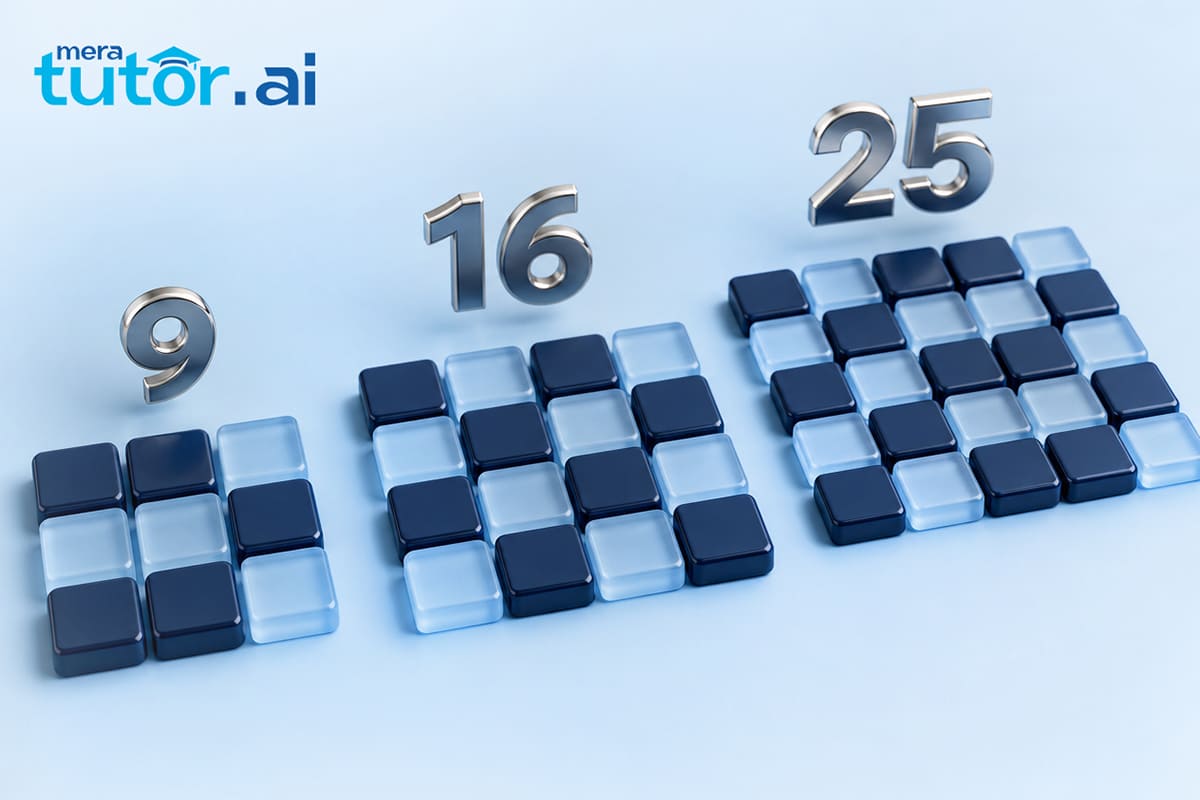
A perfect square is a number you get by multiplying an integer by itself, and Class 8 students are expected to recognise the first 20 perfect squares by sight. A few properties worth memorising before attempting the worksheet:
- A number ending in 2, 3, 7, or 8 is never a perfect square.
- The square of an even number is always even; the square of an odd number is always odd.
- Perfect squares can be found using prime factorisation — every prime factor must appear an even number of times.
- The number of digits in a perfect square is either double the digits in its root, or one less than double — a quick sanity check for estimation.
Quick Recap: Cubes and Cube Roots (Class 8)
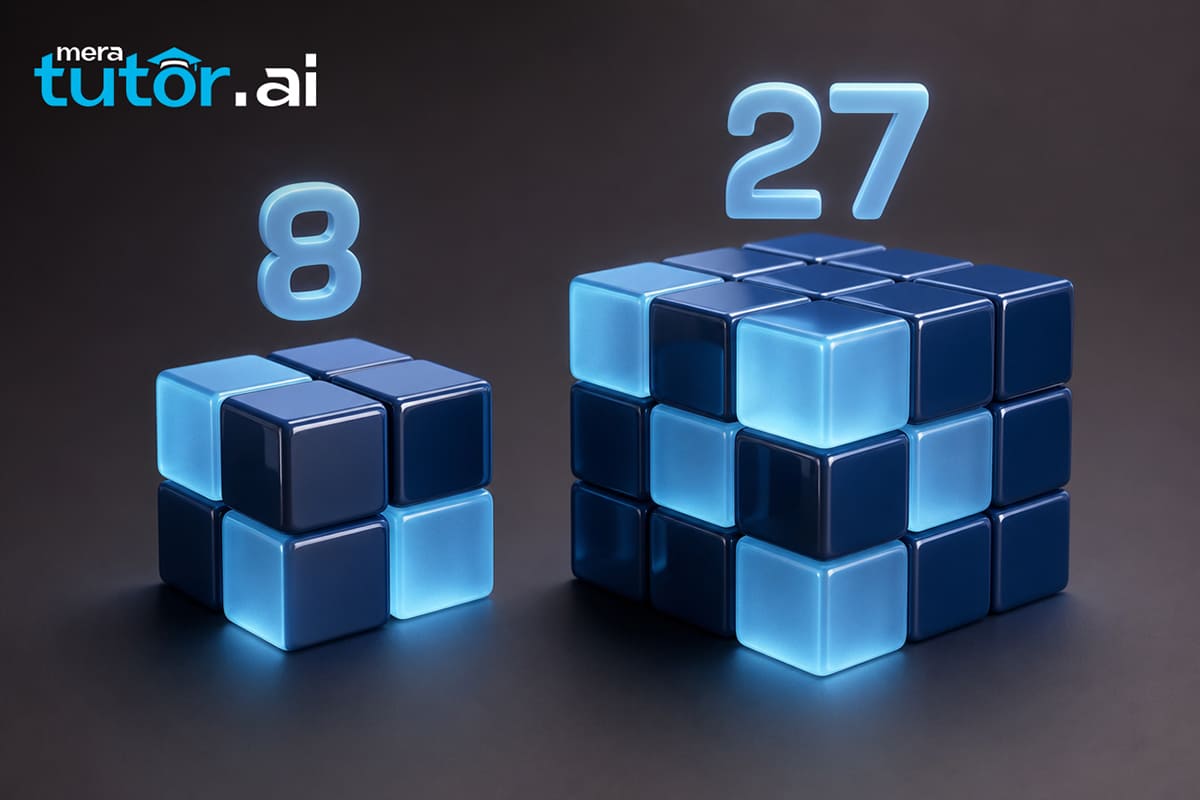
A perfect cube is a number obtained by multiplying an integer by itself three times, and unlike square roots, cube roots can be negative because a negative number cubed stays negative (e.g., (−2)³ = −8). Key properties:
- A perfect cube’s prime factors must each appear in groups of three.
- The cube of an even number is even; the cube of an odd number is odd.
- Cube roots of large perfect cubes can be found quickly by grouping digits in threes from the right and matching unit-digit patterns — a shortcut Class 8 students are taught explicitly.
- A number with zeros at the end is a perfect cube only if the zeros come in multiples of three (e.g., 1,000 and 27,000 qualify; 100 and 1,00,000 don’t).
Free A Square and a Cube Class 8 Worksheet with Answers (25 Questions)
This a square and a cube Class 8 worksheet with answers has 25 questions across five sections — MCQs, fill-in-the-blanks, short answers, HOTS/pattern questions, and a bonus practice set — matching the difficulty level of school unit tests and the NCERT Ganita Prakash exercises. Suggested time: 40–45 minutes.
Section A: Multiple Choice Questions
- Which of these is a perfect square? (a) 226 (b) 361 (c) 512 (d) 148
- The cube of 6 is: (a) 36 (b) 196 (c) 216 (d) 256
- A number ending in which digit can never be a perfect square? (a) 1 (b) 4 (c) 8 (d) 9
- ∛343 = ? (a) 6 (b) 7 (c) 8 (d) 9
- Which of these numbers is a perfect cube? (a) 100 (b) 125 (c) 150 (d) 175
Section B: Fill in the Blanks
- 15² = ______
- The square root of 289 is ______.
- 9³ = ______
- The smallest 3-digit perfect square is ______.
- The cube root of −64 is ______.
Section C: Short Answer / Word Problems
- Without fully multiplying, state whether 1,458 is a perfect square. Justify using the last-digit rule.
- A square garden has an area of 225 m². Find the length of one side.
- A cube-shaped storage box has a volume of 1,000 cm³. Find the length of each edge.
- Find the smallest number by which 72 must be multiplied to make it a perfect square.
- Find the cube root of 2,744 using prime factorisation.
Section D: HOTS / Pattern-Based Questions
- Study the pattern: 1² = 1, 11² = 121, 111² = 12321. Predict 1111².
- If a number has 5 zeros at the end, can it be a perfect cube? Explain.
- Show that the sum of the first n odd numbers is always a perfect square, for n = 5.
- Between which two consecutive perfect squares does 200 lie?
- A school is arranging 512 students into a cube-shaped formation (equal rows, columns, and layers). Is this possible? Show your working.
Section E: Bonus Practice
- Find the smallest number by which 250 must be divided to make it a perfect cube.
- Is 1,024 a perfect square, a perfect cube, both, or neither? Show your reasoning.
- A cube has a total surface area of 384 cm². Find the volume of the cube.
- Find two consecutive perfect cubes between which 500 lies.
- If the square root of a number is 23, what is the number, and what is its cube root’s approximate value (to 1 decimal place)?
A Square and a Cube Class 8 Worksheet with Answers — Step-by-Step SolutionsAnswers with Step-by-Step Solutions
Full answer key for the Class 8 squares and cubes worksheet is below, with worked solutions for every Section C, D, and E question so students can check their method, not just their final answer.
Answer Key — Sections A & B
- (b) 361
- (c) 216
- (c) 8
- (b) 7
- (b) 125
- 6. 225
- 7. 17
- 8. 729
- 9. 100
- 10. −4
Section C — Worked Solutions
11. Is 1,458 a perfect square?
No. A perfect square never ends in 2, 3, 7, or 8. Since 1,458 ends in 8, it cannot be a perfect square — no further calculation is needed.
12. Square garden, area 225 m²
Side = √225 = 15 m, since 15 × 15 = 225.
13. Cube box, volume 1,000 cm³
Edge = ∛1,000. Prime factorising 1,000 gives 2×2×2×5×5×5, which groups into (2×5)³ = 10³. So each edge measures 10 cm.
14. Smallest multiplier to make 72 a perfect square
Prime factorise 72 = 2×2×2×3×3. Grouping in pairs leaves one lone 2 unpaired. Multiplying by 2 gives 2×2×2×2×3×3 — all factors paired — so the smallest multiplier is 2, and 72 × 2 = 144 = 12².
15. Cube root of 2,744
Prime factorising 2,744 gives 2×2×2×7×7×7 = (2×7)³ = 14³. So ∛2,744 = 14.
Section D — Worked Solutions
16. Pattern: predict 1111²
Following 1² = 1, 11² = 121, 111² = 12321, the pattern of digits counts up then down. So 1111² = 1234321.
17. Can a number with 5 trailing zeros be a perfect cube?
No. A perfect cube needs its trailing zeros in multiples of three (0, 3, 6, 9…). Five zeros is not a multiple of three, so such a number cannot be a perfect cube.
18. Sum of first 5 odd numbers
1 + 3 + 5 + 7 + 9 = 25 = 5², confirming the rule that the sum of the first n odd numbers equals n².
19. 200 lies between which perfect squares?
14² = 196 and 15² = 225, so 200 lies between 196 and 225 — i.e., between 14² and 15².
20. Can 512 students form a cube formation?
Prime factorising 512 gives 2⁹, which groups into (2³)³ = 8³. So ∛512 = 8 — meaning 8 rows, 8 columns, and 8 layers. Yes, the formation is possible.
Section E — Worked Solutions
21. Smallest divisor to make 250 a perfect cube
Prime factorise 250 = 2×5×5×5. The 5s already form a group of three, but the 2 is alone. Dividing by 2 removes the unpaired factor, leaving 5×5×5 = 125 = 5³. So the smallest number to divide by is 2.
22. Is 1,024 a perfect square, cube, both, or neither?
1,024 = 2¹⁰. Since 10 is even, 1,024 is a perfect square (32² = 1,024). Since 10 is not a multiple of 3, it is not a perfect cube.
23. Cube with surface area 384 cm² — find volume
Total surface area = 6 × (edge)², so (edge)² = 384 ÷ 6 = 64, giving edge = 8 cm. Volume = 8³ = 512 cm³.
24. Consecutive perfect cubes around 500
7³ = 343 and 8³ = 512, so 500 lies between 343 and 512 — i.e., between 7³ and 8³.
25. Square root is 23 — find the number and estimate its cube root
The number is 23² = 529. Its cube root is between 8³ = 512 and 9³ = 729, and closer to 512, so ∛529 ≈ 8.1.
Common Mistakes Students Make (and How to Avoid Them)
The most common Class 8 squares-and-cubes mistake is confusing square roots with cube roots when a number could plausibly be either — always check by grouping prime factors in twos (square) versus threes (cube) rather than guessing. Working through a square and a cube Class 8 worksheet with answers is the fastest way to catch these mistakes before an exam.
- Forgetting that cube roots of negative numbers are valid, but square roots of negative numbers are not covered at this level.
- Skipping the last-digit check before attempting full factorisation, which wastes time on numbers that are obviously not perfect squares.
- Miscounting zeros when checking if a number is a perfect square (needs an even number of zeros) or a perfect cube (needs a multiple of three zeros).
- Mixing up the pattern-based questions with straightforward calculation questions — HOTS questions usually need a rule to be spotted first, not just arithmetic.
- Rushing surface-area-to-volume conversions (like Q23) without first isolating the edge length — always solve for the edge before cubing it.
How to Get More Class 8 Worksheets Like This
You can generate unlimited, board-aligned worksheets for any Class 8 Maths chapter — with instant AI evaluation and step-by-step feedback — using MeraTutor.AI’s worksheet generator. If this a square and a cube Class 8 worksheet with answers helped, MeraTutor.AI can generate similar sets for every Class 8 chapter.
Beyond one-off worksheets, MeraTutor.AI’s AI tutor adapts to each student’s pace across CBSE, ICSE, IB, and State Board syllabi, tracking weak areas like squares and cubes automatically. Explore what’s included on the features page, compare plans on the pricing page, or see how live online tutoring sessions build on worksheet practice. Parents who’d rather browse ready-made worksheets first can start at the free worksheets library, or head straight to the Class 8 Maths “Squares and Cubes” chapter page.

Want unlimited Class 8 worksheets like this, evaluated instantly?
Free AI-generated worksheets across CBSE, ICSE, IB & State Boards.
Try Free AI Worksheets →Frequently Asked Questions
1. Which chapter is “A Square and a Cube” in Class 8 Maths?
“A Square and a Cube” is Chapter 1 of the NCERT Ganita Prakash Class 8 Maths textbook. Older NCERT editions and some State Boards split the same topic into “Squares and Square Roots” and “Cubes and Cube Roots.”
2. What is the difference between a square and a cube in Class 8 Maths?
A square is a number multiplied by itself once (a²), while a cube is a number multiplied by itself twice more (a³) — squares relate to area, cubes relate to volume.
3. How can I identify a perfect square quickly?
Check the last digit first — numbers ending in 2, 3, 7, or 8 are never perfect squares — then confirm with prime factorisation, where every factor should appear an even number of times.
4. How can I check if a number is a perfect cube?
Write the number’s prime factorisation and check that every prime factor appears in a group of exactly three; if it does, the number is a perfect cube.
5. Can a cube root be negative?
Yes. Unlike square roots, cube roots can be negative, because a negative number cubed still gives a negative result — for example, ∛(−64) = −4.
6. Where can I get more Class 8 worksheets with instant answers?
MeraTutor.AI’s free AI worksheet generator creates board-aligned Class 8 worksheets on demand and evaluates them instantly, so students get step-by-step feedback the same way this post does.
A square and a cube Class 8 worksheet with answers is most useful when it’s practised alongside a full concept recap and worked examples, not just as a stand-alone answer key — use the sections above in that order for best results.
7. Is this a square and a cube Class 8 worksheet with answers free to use?
Yes — this a square and a cube Class 8 worksheet with answers is completely free to download and print, and matches CBSE, ICSE, IB and State Board difficulty levels.
