


Table of Contents
Every Class 7 Maths student meets big numbers before they meet big ideas — populations counted in crores, distances measured in kilometres, and school or festival budgets running into lakhs. This large numbers around us class 7 worksheet is built around NCERT’s Chapter 1, Ganita Prakash, and gives your child structured practice in reading, writing, comparing, and estimating large numbers, along with applying them to real-world word problems. Below, you will find exactly what the chapter covers, sample question types, common mistakes to watch for, and a direct link to download the full worksheet — free, with an answer key.
What Does the Large Numbers Around Us Class 7 Worksheet Actually Cover?
The chapter introduces students to numbers beyond six digits and teaches them to read, write, compare, round off, and apply these numbers to everyday situations such as population counts, distances, and money.
- Reading and writing numbers in the Indian and International place-value systems
- Converting between the two systems (lakh and crore versus thousand and million)
- Estimating and rounding off large numbers to the nearest ten, hundred, or thousand
- Comparing large quantities such as populations, budgets, and production figures
- Solving word problems that use large numbers in daily-life contexts
This is exactly the ground covered in a large numbers around us class 7 worksheet, which is why focused practice papers matter as much as the classroom lesson itself.
How This Chapter Fits Into the CBSE Class 7 Maths Syllabus
This chapter — Chapter 1 of Ganita Prakash, the current NCERT Class 7 Maths textbook — sets the foundation for several chapters that follow. Estimation skills built here carry into later work on arithmetic expressions and data handling, while comfort with the Indian number system and International number system supports Social Science topics like population and economic data.
Because it opens the year, teachers often move through this chapter quickly, assuming students already have a working sense of place value from Class 6. In practice, many children need one or two rounds of focused revision before the concept fully sticks — which is exactly the gap a well-structured worksheet is meant to close.
- Builds directly on place-value work from Class 6 Maths
- Feeds into estimation and rounding used in later Class 7 chapters
- Supports population and data-based questions in Social Science
- Prepares students for large-number operations introduced in Class 8
Indian vs. International Number System — The Core Skill in This Chapter
Most mistakes in this chapter come from mixing up the Indian system (ones, tens, hundreds, thousand, lakh, crore) with the International system (ones, tens, hundreds, thousand, million, billion), and a large numbers around us class 7 worksheet is the fastest way to fix that confusion.
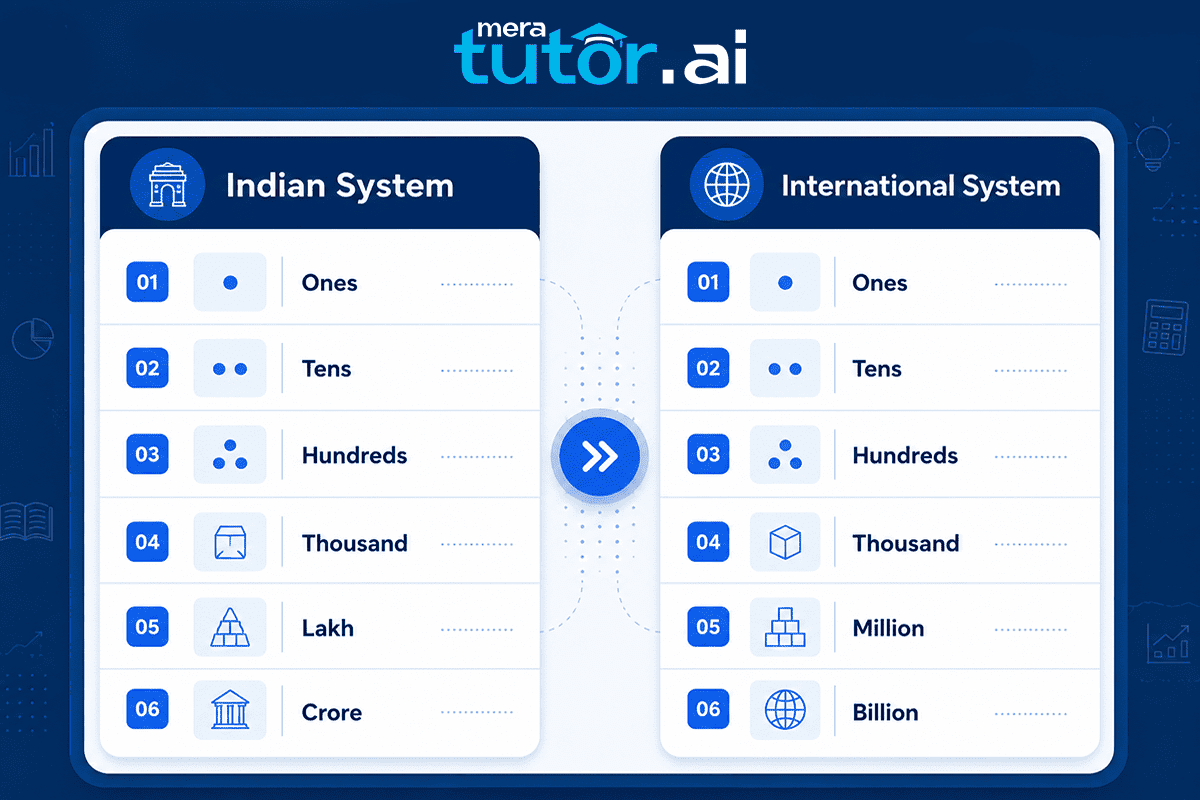
| Digits (from right) | Indian System | International System |
|---|---|---|
| 1st – 3rd | Ones, Tens, Hundreds | Ones, Tens, Hundreds |
| 4th – 5th | Thousand, Ten Thousand | Thousand, Ten Thousand |
| 6th – 7th | Lakh, Ten Lakh | Hundred Thousand, Million |
| 8th – 9th | Crore, Ten Crore | Ten Million, Hundred Million |
Once a child can place commas correctly in both systems, reading and writing any large number — whether it is India’s population or the distance to the Moon — becomes far easier and far less error-prone.
Why Practising Large Numbers Matters Beyond the Exam
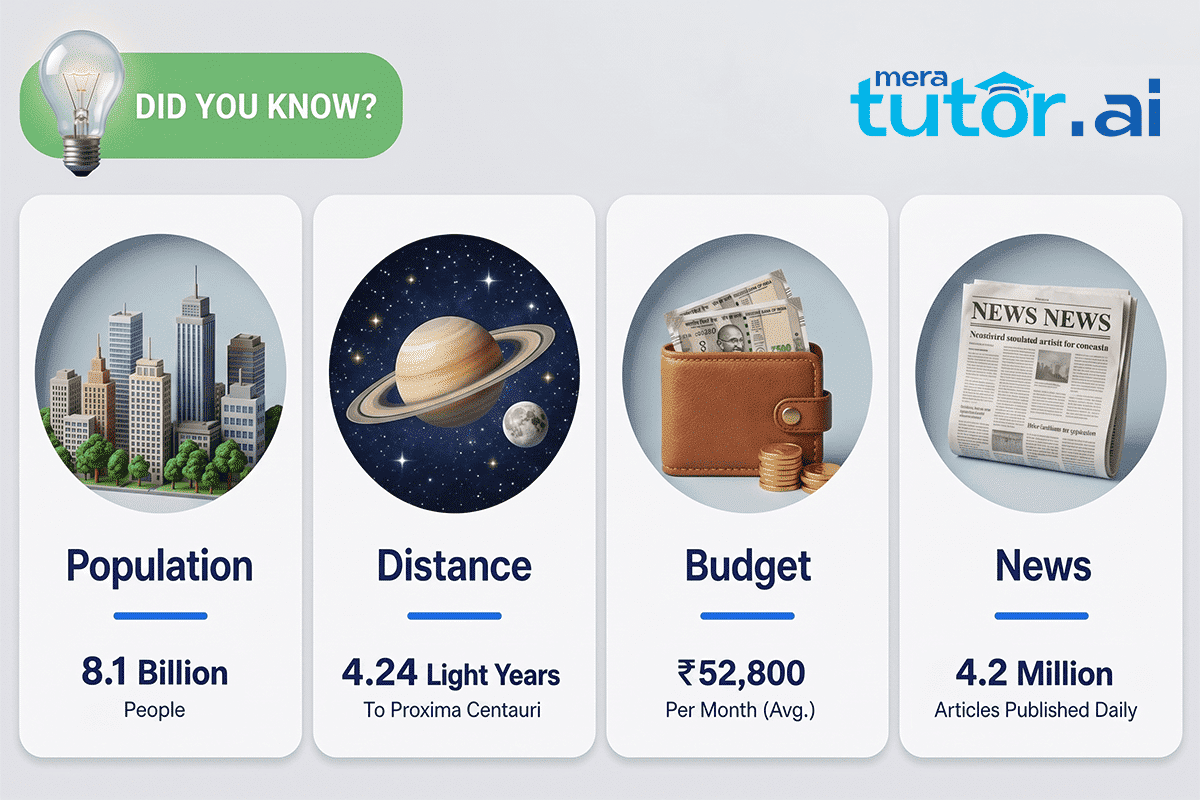
Large numbers show up constantly outside the maths notebook — in news reports, cricket scores, festival crowd counts, and household budgets — so strong number sense here supports every subject that works with data, not just Maths.
- Reading population and census figures correctly in Social Science
- Understanding astronomical distances in Science, such as Earth to Sun or Earth to Moon
- Making sense of family or school budgets that run into lakhs
- Following news reports on GDP, elections, or sports viewership numbers
- Building the estimation habits used later in Data Handling and Statistics
Children who practise this chapter well tend to move through Data Handling, Statistics, and even Social Science map-and-population questions with noticeably less friction later in the year, simply because reading a seven- or eight-digit number no longer slows them down.
Sample Questions From the Large Numbers Around Us Class 7 Worksheet
A good large numbers around us class 7 worksheet mixes four question types — place value, conversion between systems, estimation, and applied word problems — so children practise the underlying concept, not just a calculation shortcut.
- Write 8,45,32,109 in words using the Indian system, and again using the International system.
- Round 47,68,213 to the nearest lakh, and separately to the nearest ten thousand.
- A city’s population is recorded as 92,45,678. Express this using commas correctly in both the Indian and International systems.
- Arrange these quantities in ascending order: 5 crore 6 lakh, 50,60,000, and 5,60,00,000.
- A school collected ₹12,45,600 in fees this term. Round this figure off to the nearest ten thousand.
These are representative examples only. The full downloadable worksheet includes complete Easy, Medium, and Hard question sets with a full answer key.
Each level is designed by CBSE-experienced educators and mapped to the current NCERT syllabus, so the questions match what a Class 7 student is actually likely to see in a class test or unit exam — not generic number puzzles borrowed from a different curriculum. The Easy set focuses on reading, writing, and basic place value; Medium introduces system conversion and estimation; Hard combines all of these inside multi-step word problems, closer to what shows up in periodic assessments.
| Level | Focus | Includes |
|---|---|---|
| Easy | Reading, writing, basic place value | ✓ Printable PDF ✓ Answer key |
| Medium | System conversion, estimation | ✓ Printable PDF ✓ Answer key |
| Hard | Multi-step word problems, comparisons | ✓ Printable PDF ✓ Answer key ✓ Exam-style questions |
Common Mistakes Students Make and How to Avoid Them
- Misplacing commas when switching between the Indian and International systems
- Rounding to the wrong place value, such as nearest hundred instead of nearest thousand
- Dropping or adding an extra zero when writing numbers out in words
- Confusing “lakh” with “million,” or “crore” with “billion,” during conversions
- Rushing through word problems without first underlining the actual large number involved
A large numbers around us class 7 worksheet that comes with a proper answer key helps children catch these errors themselves, well before a school test does.
What Parents Can Do at Home Between Worksheet Sessions
You do not need to teach the chapter yourself to help. A few simple habits at home reinforce everything the worksheet is designed to practise:
- Ask your child to read out large numbers from a newspaper headline or a cricket scoreboard, in both systems
- Keep a simple Indian and International place-value chart taped near the study table for quick reference
- Turn a family budget or grocery bill into a rounding-off exercise once a week
- Let your child check their own worksheet against the answer key before you review it, so they build the habit of self-checking
Ten to fifteen minutes of this kind of everyday practice, alongside the structured worksheet, is usually enough to move a child from feeling confused by commas to confident with large numbers.
How to Download the Free Class 7 Large Numbers Worksheet
The complete large numbers around us class 7 worksheet — Easy, Medium, and Hard levels, each with a full answer key — is free to download from MeraTutor.AI’s worksheet library.
- Choose Easy, Medium, or Hard based on where your child stands right now
- Every level includes a printable PDF plus a full answer key
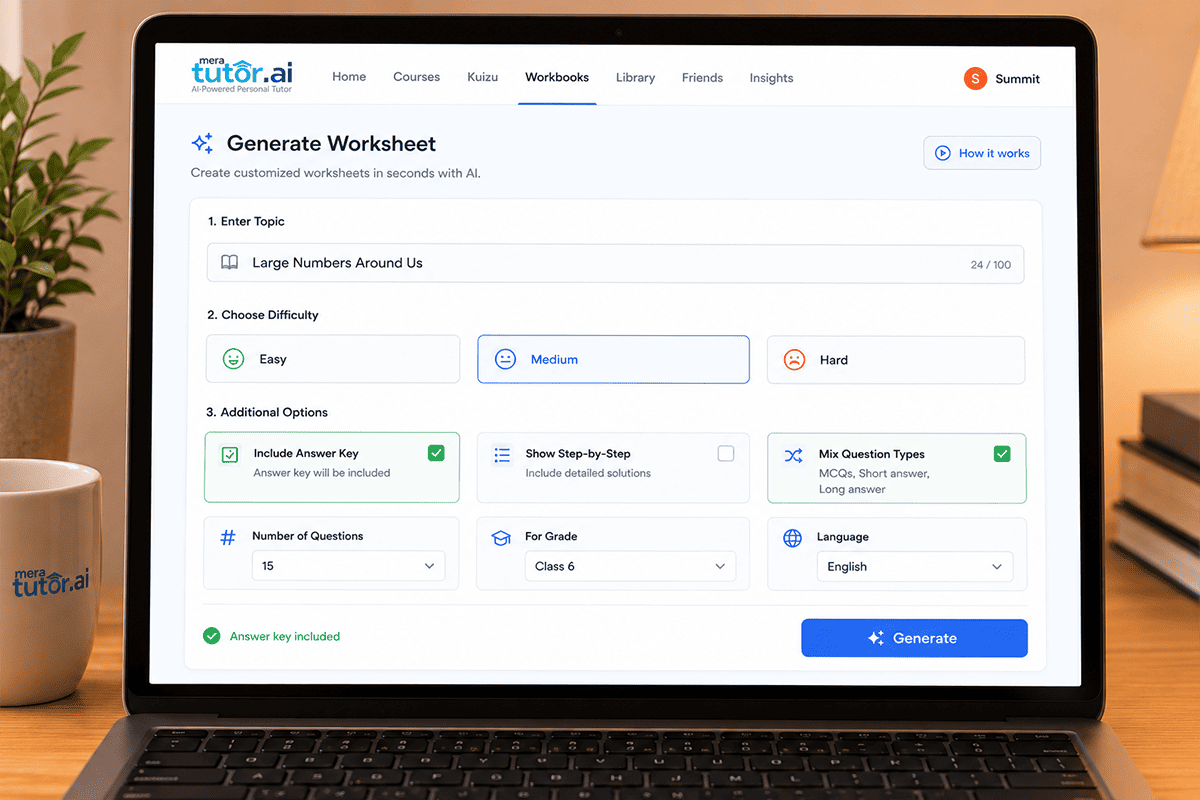
- Sign up to unlock the AI worksheet generator, which creates unlimited fresh large-numbers practice sets in seconds
- Snap a photo of a completed worksheet and get instant, AI-graded feedback
Beyond the Worksheet — Extra Support When Large Numbers Still Feel Confusing
Worksheets are a strong starting point, but some children need the concept explained out loud, in a different way, before it clicks. If that’s the case for your child, MeraTutor.AI’s full feature set pairs AI-graded practice with live, personalised sessions — so the same large-numbers gap gets addressed from more than one angle.
- One-on-one online tutoring for children who need the concept explained a different way
- AI grading that reads handwritten answers and gives step-by-step feedback the same day
- Progress tracking so parents can see exactly which place-value or estimation errors keep repeating
- A free trial to test the AI tutor before committing, and transparent plans on the pricing page
Give your child unlimited AI-generated large numbers practice — free.
Try FreeFrequently Asked Questions About the Large Numbers Around Us Class 7 Worksheet
Q1: What is the large numbers around us class 7 worksheet based on?
It is based on Chapter 1, “Large Numbers Around Us,” from NCERT’s Ganita Prakash textbook, covering place value, the Indian and International number systems, estimation, and real-life applications.
Q2: What topics does this worksheet cover?
It covers reading and writing large numbers, converting between the Indian and International systems, rounding off and estimation, comparing large quantities, and word problems based on population, distance, and money.
Q3: Is the worksheet free to download?
Yes. The Easy, Medium, and Hard versions are all free to download, complete with a full answer key, from MeraTutor.AI’s worksheet library.
Q4: How can I tell which difficulty level my child should start with?
Start with the Easy level if your child is still unsure about place value in either number system, move to Medium once they can convert confidently between systems, and to Hard once they can compare and estimate without help.
Q5: My child keeps confusing lakh, crore, million, and billion — what helps?
Practising side-by-side conversion questions, like the ones in this worksheet, alongside a simple place-value chart is usually enough to fix this within a week or two of regular practice.
Q6: Can I get unlimited new worksheets on this topic instead of just one PDF?
Yes. Signing up unlocks the AI worksheet generator, which creates fresh large-numbers practice sets matched to your child’s level in seconds.
Conclusion
Large numbers stop feeling abstract the moment a child connects them to something real — a population count, a festival crowd, a family budget. That is the real goal of this chapter, and of any large numbers around us class 7 worksheet worth using: not just correct answers, but number sense that carries into every subject dealing with data. Download the free worksheet, work through it with your child this week, and use the answer key to spot exactly where a little extra practice is needed.
Disclaimer: The educational content, examples, and figures in this article are provided for general learning and practice purposes only. While every effort has been made to align this worksheet and its explanations with the NCERT/CBSE Class 7 Mathematics syllabus, please cross-check the current academic year’s official curriculum and your child’s school guidelines, as syllabi and question patterns may be revised from time to time. This article does not replace classroom instruction or a qualified teacher’s guidance.
