


Table of Contents
A particulate nature of matter class 8 worksheet is the fastest way to turn a concept-heavy NCERT chapter into marks your child can actually score. CBSE Class 8 Science Chapter 7 introduces the idea that everything around us; chalk, water, even the air inside a balloon, is made up of tiny, constantly moving particles. It’s an idea students can’t see directly, so most need repeated, varied practice rather than a single reading to feel confident with terms like diffusion, interparticle space, and states of matter. This guide explains what the chapter covers, what a genuinely useful worksheet should include, and gives you a free, ready-to-print particulate nature of matter class 8 worksheet that your child can start using today.
What Is the Particulate Nature of Matter? (Quick Answer)
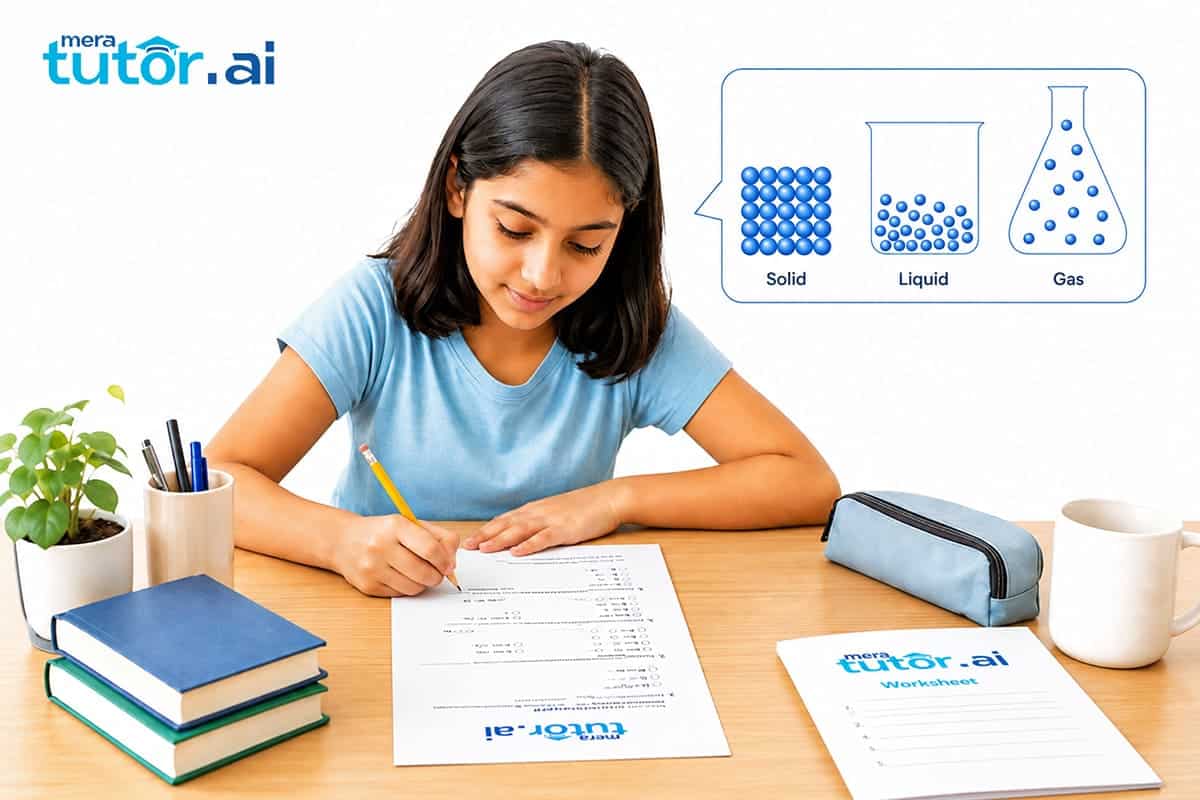
The particulate nature of matter is the scientific idea that all matter; solid, liquid, or gas, is made up of extremely small particles (atoms and molecules) that are constantly moving and held together by interparticle forces of attraction. CBSE Class 8 Science Chapter 7 builds this idea through everyday activities: grinding a piece of chalk, smelling perfume from across a room, and comparing how tightly particles are packed in solids, liquids, and gases.
Four ideas anchor this chapter, and a good particulate nature of matter class 8 worksheet should test all four:
- Matter is made of particles too small to be seen even with a simple microscope.
- These particles are always moving, the motion never stops, even in solids.
- Interparticle forces of attraction are strongest in solids, weaker in liquids, and weakest in gases.
- Diffusion, particles mixing on their own, happens because particles are in constant motion, and it is fastest in gases.
Why Students Need a Particulate Nature of Matter Class 8 Worksheet for This Chapter
Chapter 7 is abstract: there’s nothing for a student to physically see moving, so definitions and diagrams get memorized without being understood. CBSE exam papers for this chapter typically mix short definition-recall questions with reasoning-based ones (“why does smell spread faster in a gas than in water?”), and students who’ve only read the chapter often stumble on the reasoning half. Repeating a particulate nature of matter class 8 worksheet across easy, medium, and hard difficulty is what closes that gap, because it forces a student to apply the same core idea in several different situations instead of recalling it once.
What’s Inside the Free MeraTutor.AI Particulate Nature of Matter Class 8 Worksheet
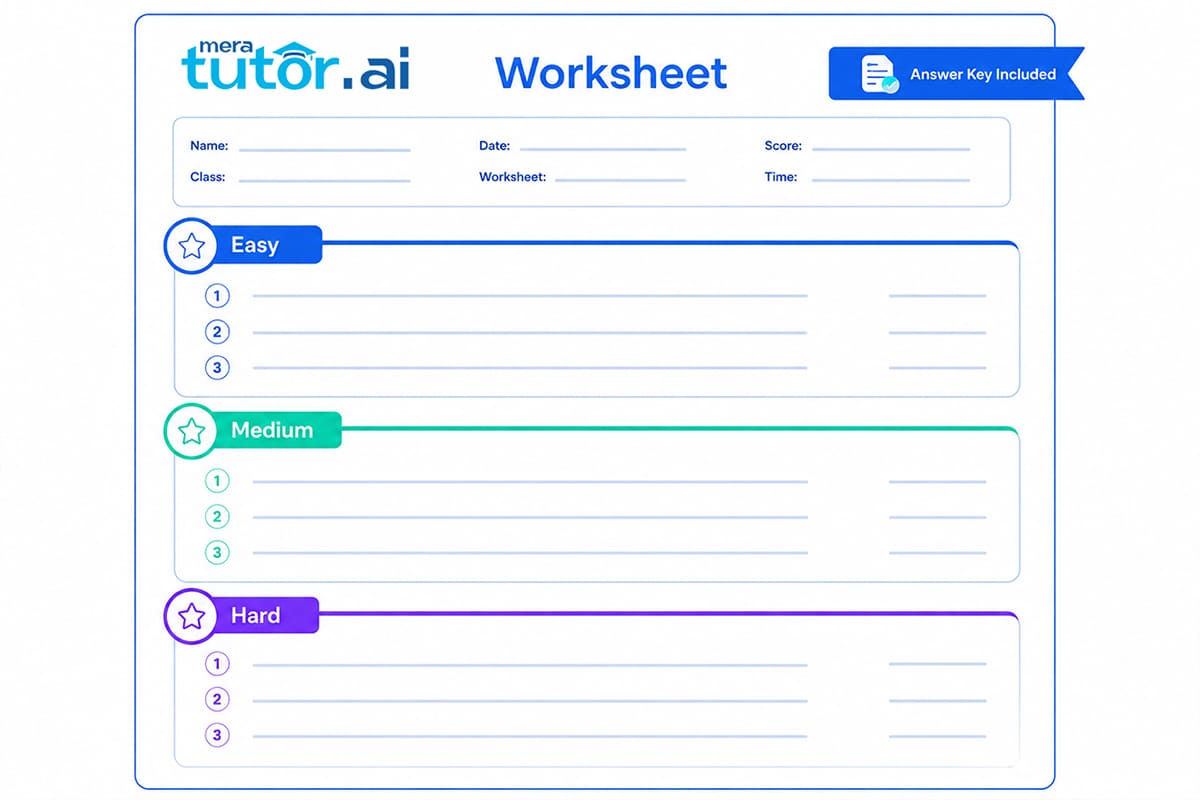
The free particulate nature of matter class 8 worksheet on MeraTutor.AI is built around three difficulty bands, so it works whether your child is just starting the chapter or revising before a test:
- Easy — definitions and direct recall (what is a constituent particle, what is diffusion).
- Medium — short reasoning questions (why gases diffuse faster than liquids, comparing interparticle space across states).
- Hard — applied and diagram-based questions that mirror the CBSE exam pattern.
Every level comes with an answer key, the PDF downloads instantly with no account or email sign-up, and it’s free to use as many times as needed.
Key Topics Covered in the Particulate Nature of Matter Class 8 Worksheet
The particulate nature of matter class 8 worksheet is mapped directly to the chapter’s core topics, so practice stays aligned with what’s actually taught in class:
- What matter is composed of, and how grinding or breaking a substance is a physical change, not a change in what it’s made of.
- Constituent particles, atoms and molecules, as the basic building blocks of matter.
- Interparticle space: why even a “solid” chair has tiny gaps between its particles.
- Interparticle forces of attraction, and how their strength differs across solids, liquids, and gases.
- How particle arrangement and motion explain the fixed shape of solids versus the free-flowing nature of gases.
- Diffusion, and everyday examples like the smell of food or perfume spreading through a room.
- How thermal energy affects particle motion (the balloon-over-a-bottle activity from the textbook).
- Why gases are easy to compress and liquids and solids are not.
How to Use This Particulate Nature of Matter Class 8 Worksheet at Home: A Simple 4-Step Study Routine
- Read the chapter summary first. A 5-minute recap of the four core ideas above makes the worksheet questions click faster than jumping in cold.
- Start with the Easy sheet. Let your child answer without notes, then check against the answer key together, this shows you exactly where the gaps are.
- Move to Medium and Hard only after Easy feels comfortable. Reasoning questions build on the same definitions, so skipping ahead usually backfires.
- Photograph the completed particulate nature of matter class 8 worksheet and let MeraTutor.AI’s AI grading review it for instant, detailed feedback instead of waiting for a teacher to mark it.

Common Mistakes Students Make in This Chapter and How a Particulate Nature of Matter Class 8 Worksheet Fixes Them
- Treating “atom” and “molecule” as interchangeable — repeated short-answer practice makes the distinction stick.
- Assuming particles in a solid don’t move at all — worksheet questions on vibration-in-place versus free movement correct this directly.
- Forgetting that even tightly packed solids have interparticle space — a common diagram-labelling mistake in exams.
- Thinking diffusion only happens in gases, when it happens in liquids too, just more slowly — a favourite CBSE reasoning question.
MeraTutor.AI vs Other Particulate Nature of Matter Class 8 Worksheet Websites
Several sites host Class 8 Science chapter notes and solutions, including Vedantu, which lists most of its Class 8 Science Chapter 7 PDF downloads as requiring sign-in on its own site. MeraTutor.AI’s worksheet for this chapter is built for quick, no-friction practice instead:

Frequently Asked Questions
1. What is the particulate nature of matter in Class 8 Science?
It is the idea taught in CBSE Class 8 Science Chapter 7 that all matter is made up of extremely small, constantly moving particles (atoms and molecules) held together by interparticle forces, and this particulate nature of matter class 8 worksheet tests exactly that concept across easy, medium, and hard questions.
2. Is this particulate nature of matter class 8 worksheet based on the latest NCERT syllabus?
Yes, the worksheet is aligned to the current CBSE Class 8 Science Chapter 7 syllabus, covering constituent particles, interparticle space and forces, diffusion, and states of matter.
3. Do I need to sign up to download the particulate nature of matter class 8 worksheet?
No, the PDF downloads instantly with no account or email required; you can find it on the MeraTutor.AI free worksheets page.
4. What difficulty levels are included in the particulate nature of matter class 8 worksheet?
The worksheet has three levels; Easy, Medium, and Hard, each with its own answer key, so students can progress from basic recall to CBSE-exam-style reasoning questions.
5. How can I check my child’s answers without waiting for a teacher?
You can photograph the completed particulate nature of matter class 8 worksheet and use MeraTutor.AI’s AI-powered handwriting grading for instant, detailed feedback.
6. Is this chapter important for Class 8 exams?
Yes, Particulate Nature of Matter is a scoring chapter that’s frequently tested with both short-answer and reasoning-based questions, so regular worksheet practice is one of the most effective ways to prepare for it.
Download Your Free Particulate Nature of Matter Class 8 Worksheet Now
Give your child focused, exam-ready practice with this free particulate nature of matter class 8 worksheet, no sign-up, answer keys included. Want AI grading, personalized practice, and progress tracking too? Try MeraTutor.AI free.
Ready for more than a worksheet? Get AI-powered practice, grading, and progress tracking.
Try Free