



Table of Contents
Personalized learning platforms for students use AI to find where each child is stuck, then adjust explanations, practice and pace to match. For Indian students in Classes 6–10, this matters most in maths, where one missed concept can quietly weaken every chapter that follows.
This guide explains how personalized learning platforms for students work, shows illustrative Class 6–10 maths examples of gap detection and step-by-step help, and lists what CBSE, ICSE, IB and State Board parents should look for before choosing an AI tutor.
What Are Personalized Learning Platforms for Students?
Personalized learning platforms for students are digital tools that adapt content, pace and feedback to each learner’s strengths and gaps, instead of teaching every child the same way.
A good platform usually does four things:
- Checks what the student already knows.
- Breaks problems into smaller, guided steps.
- Gives practice that matches the student’s level.
- Shows progress to parents and teachers.
This is different from a video library or a plain answer-checker. Personalized learning platforms for students respond to what the child actually types, so the help changes from one student to the next.
In practice, a personalized learning platform for students acts like a patient AI tutor that never rushes. It lets a child repeat a question, revisit a chapter or slow down on a hard concept without feeling judged.
Why Personalized Learning Platforms for Students Matter in India
Personalized learning platforms for students matter in India because one classroom teacher rarely has time to adapt to every learner’s level, and early maths gaps tend to grow.
- Learning gaps are real. ASER 2024, a survey of rural India, found that only 30.7% of Class 5 children could solve a division problem, and basic arithmetic proficiency among Class 8 children stood at 45.8%.
- Policy supports technology. India’s National Education Policy 2020, approved in July 2020, seeks to strengthen the use of technology in education.
These figures cover rural India only, but they show why personalized learning platforms for students can help: they give step-by-step, self-paced support exactly where a child is stuck.
For urban families, the same logic applies. Even in well-resourced schools, a child who is weak in one chapter needs targeted practice, and personalized learning platforms for students can provide it at home, at any hour.
How AI Personalizes Learning: The 4-Step Loop
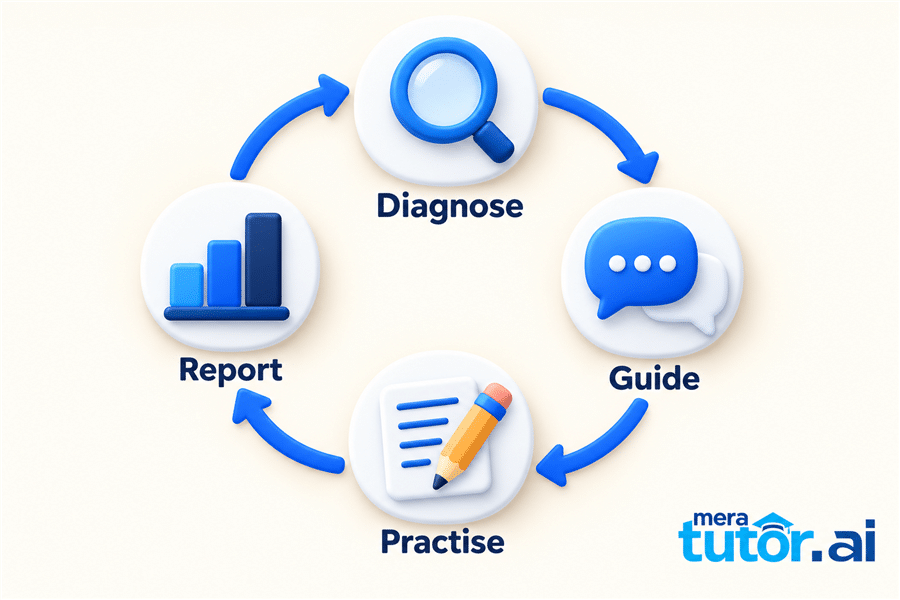
AI personalizes learning in four steps: it diagnoses the gap, guides the student, assigns matching practice, and reports progress. This loop is what separates personalized learning platforms for students from ordinary study apps.
- Diagnose: The AI reads the student’s questions and answers to spot the exact concept that is weak.
- Guide: It breaks the problem into smaller steps instead of only giving the final answer.
- Practise: It offers quiz and worksheet questions at a suitable difficulty.
- Report: It records activity so parents can see what was studied and where help is needed.
The loop repeats every time the student studies. Each new answer gives the AI tutor a clearer picture, so the next explanation and the next practice question become more precise.
Real Examples: How Personalized Learning Platforms for Students Handle Class 6–10 Maths
Here are five illustrative examples of how personalized learning platforms for students respond to common Class 6–10 maths mistakes. They are teaching scenarios, not recorded student sessions, and real responses vary by platform and question.
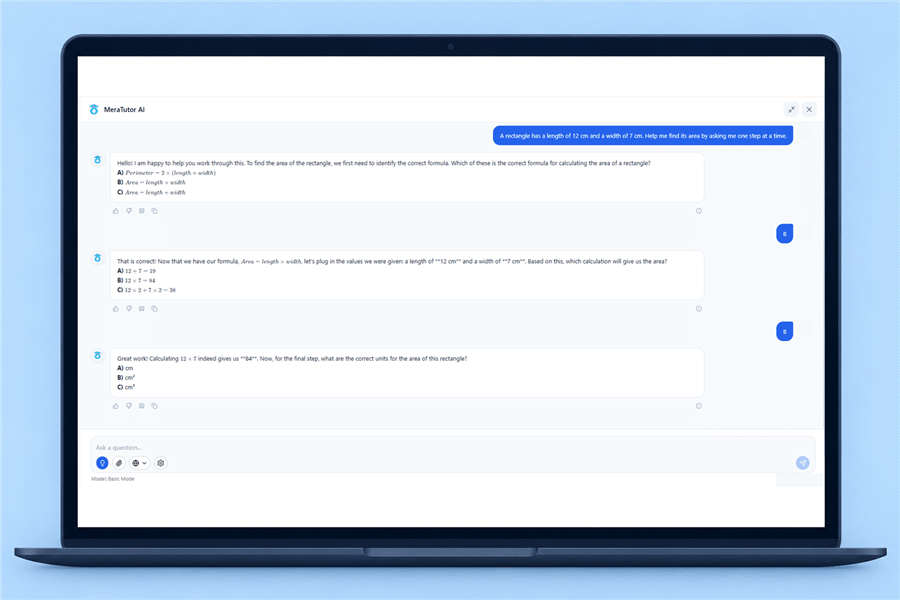
In each case, the platform does not simply reveal the answer. It finds the gap, asks a guiding question and offers step-by-step maths help until the student can explain the idea in their own words.
Class 6: Adding Unlike Fractions
- Common mistake: Adding top and bottom numbers, so 1/2 + 1/3 becomes 2/5.
- Gap detected: The idea of equal-sized pieces (a common denominator).
- Personalized help: The AI asks what each fraction represents, then guides the child to rewrite both with the same denominator before adding.
Practise more with the Class 6 maths worksheets
Class 7: Forming Algebraic Expressions
- Common mistake: Writing “5 more than x” as 5x instead of x + 5.
- Gap detected: The difference between adding and multiplying with a letter.
- Personalized help: The AI first tries a real number (say x = 3), checks the answer, then rebuilds the expression with the letter.
For a deeper walkthrough, see our guide to expressions using letters and numbers in Class 7
Class 8: Negative Exponents
- Common mistake: Reading 2⁻³ as −8.
- Gap detected: What a negative power means.
- Personalized help: The AI walks down the pattern 2³, 2², 2¹, 2⁰ and shows each step dividing by 2, so the student reaches 1/8 on their own.
Revise the chapter with our Class 8 exponents and powers worksheet
Class 9: Factorising x² + 5x + 6
- Common mistake: Choosing two numbers that add to 5 but do not multiply to 6.
- Gap detected: Checking both conditions together.
- Personalized help: The AI asks for two numbers with a product of 6 and a sum of 5, then lets the student test their pair against both rules.
Class 10: Quadratic Equations by Factorisation
- Common mistake: Solving (x − 2)(x − 3) = 6 by setting x − 2 = 6.
- Gap detected: The zero-product rule only works when the product equals zero.
- Personalized help: The AI asks, “What must be true about a product before we split it into separate factors?” and guides the student to rearrange the equation to zero first.
Try more with the Class 10 maths worksheets
What to Look for in Personalized Learning Platforms for Students
Not every app that calls itself “AI-powered” adapts to the child. The best personalized learning platforms for students show five things: board-aligned content, step-by-step guidance, adjustable practice, progress visibility for parents, and child-safe AI.
Use this list to compare any personalized learning platform for students before you subscribe:
- Board alignment: Content should match CBSE, ICSE, IB or your State Board.
- Guided steps: The AI should teach the method, not only the answer.
- Adjustable practice: Quizzes and worksheets should match the child’s level.
- Parent visibility: You should see activity and weak areas without nagging your child.
- Safety: The AI should stay on study topics and avoid harmful content.
Free, mastery-based platforms such as Khan Academy are worth exploring alongside Indian board-aligned options. Check whether the content and any AI tutoring features fit your child’s board and language before relying on one. The right choice among personalized learning platforms for students depends on your child’s class, board and learning style.
| What to look for | Why it matters | MeraTutor.AI |
|---|---|---|
| Board-aligned content | Practice should match your child’s syllabus. | ✓ CBSE, ICSE, State Board, IB |
| Step-by-step guidance | Teaches the method, not just the answer. | ✓ Coach Mode (Socratic questions) |
| Adjustable practice | Questions should match the child’s level. | ✓ Kuizu quizzes and workbooks |
| Answer evaluation | Mistakes are explained, not just marked. | ✓ Workbook Evaluation |
| Parent visibility | You can see activity and weak areas. | ✓ Daily Learning Activity Summary |
| Child-safe AI | Keeps the AI on study topics. | ✓ Chat Safety |
How MeraTutor.AI Personalizes Maths Learning
MeraTutor.AI is an AI tutor for Grades 4–12 that teaches from school-recommended textbooks and supports CBSE, ICSE, State Board and IB curricula. Among personalized learning platforms for students, MeraTutor.AI focuses on guided, textbook-based maths help. Its main personalization features include:
- Coach Mode: Uses Socratic questions to break a problem into smaller steps, so students reach the answer themselves.
- Kuizu quizzes: Creates quizzes from PDFs, notes or topics, with adjustable difficulty and formats such as MCQs, short answers and HOTS.
- Workbook creation and evaluation: Builds topic-wise worksheets, then evaluates submitted answers, highlights mistakes and explains corrections.
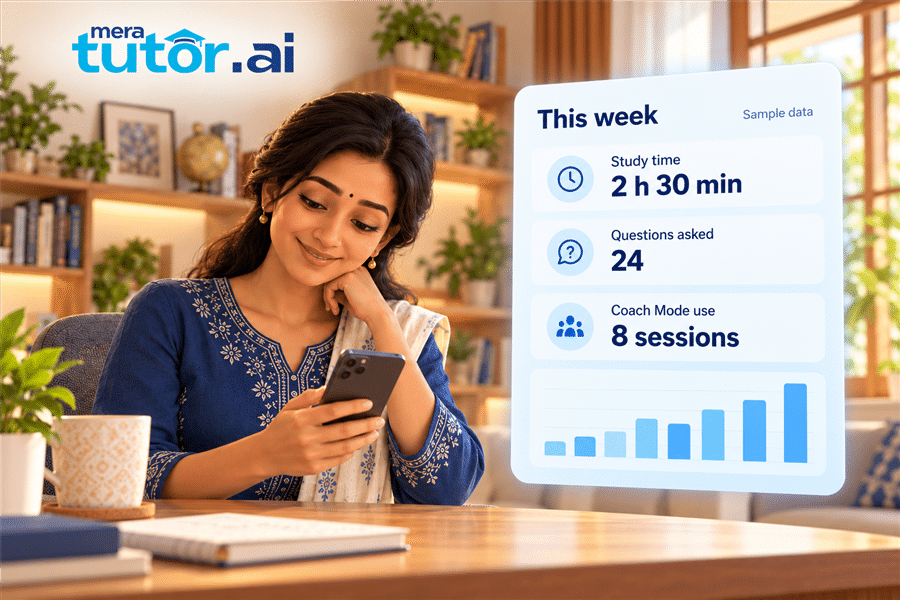
- Daily Learning Activity Summary: Shows what a student studied, questions asked, time spent and Coach Mode usage.
- Chat Safety: Avoids and logs off-topic or harmful content.
Families can start with the free AI tutor and compare paid plans on the pricing page.
How Parents Can Start With a Personalized Learning Platform
Parents can start with personalized learning platforms for students in five simple steps:
- Pick one weak maths chapter, not the whole syllabus.
- Ask your child to attempt the question first.
- Use step-by-step guidance instead of copying the final answer.
- Practise with a short quiz or worksheet on the same chapter.
- Review the activity summary weekly and revisit weak concepts.
Small, regular sessions usually work better than long, stressful ones. The goal is for the child to build confidence in Class 6–10 maths, not to finish more questions in less time.
FAQs About Personalized Learning Platforms for Students
1. What are personalized learning platforms for students?
Personalized learning platforms for students are digital tools that adapt explanations, practice and pace to each learner’s strengths and gaps. They differ from video libraries because they respond to what the student actually answers.
2. How does AI personalize maths learning for Class 6–10 students?
AI personalizes maths learning by spotting the exact step where a student goes wrong, then guiding them through smaller steps and matching practice questions. Over time, the activity record shows which concepts need more revision.
3. Do personalized learning platforms for students work for CBSE, ICSE, IB and State Board?
They can, provided the platform’s content is aligned to your child’s board. MeraTutor.AI is built as an AI tutor for Grades 4–12 that supports CBSE, ICSE, State Board and IB curricula.
4. Can a personalized learning platform replace a teacher or tutor?
No. A personalized learning platform supports school teaching and revision, but it does not replace a teacher’s guidance. Children benefit most when parents and teachers review progress alongside the platform.
5. Is there a free personalized learning platform for students in India?
Yes, free options exist. MeraTutor.AI has a free plan with basic AI tutor access and limited features; check the pricing page for current plan details.
6. How can parents track progress on a personalized learning platform?
Parents can use the platform’s activity reports. On MeraTutor.AI, the Daily Learning Activity Summary shows what a student studied, how many questions they asked, time spent and Coach Mode usage.
Final Thoughts
Personalized learning platforms for students work best when they diagnose gaps, guide step by step and keep parents informed. MeraTutor.AI offers these features for Grades 4–12 across CBSE, ICSE, State Board and IB.
If you are comparing personalized learning platforms for students this year, start with one weak chapter, test the step-by-step help, and judge the platform by how well your child understands the method.
Ready to see personalized maths help in action?
Start free and let your child try Coach Mode on a Class 6–10 maths chapter.
Try MeraTutor.AI Free