


Table of Contents
A thousands around us class 4 worksheet is any CBSE-aligned Class 4 Maths practice sheet built around Chapter 4, “Thousands Around Us” — the chapter that teaches children to read, write, and compare numbers up to 9,999 using place value. If your child has just started this chapter under the new NCERT Maths Mela syllabus, this guide walks through exactly what the chapter covers, the mistakes children make most often, and where to find a well-structured thousands around us class 4 worksheet to practice with, complete with answers.
What Is “Thousands Around Us” in CBSE Class 4 Maths?
Thousands Around Us is Chapter 4 of Class 4 Mathematics under CBSE’s new NCERT Maths Mela textbook, covering the 2025–26 syllabus onward. It introduces four-digit numbers, from 1,000 up to 9,999, through place value, expanded form, and number comparison. Every thousands around us class 4 worksheet you practice with should build on these core ideas:
- Reading and writing four-digit numbers correctly
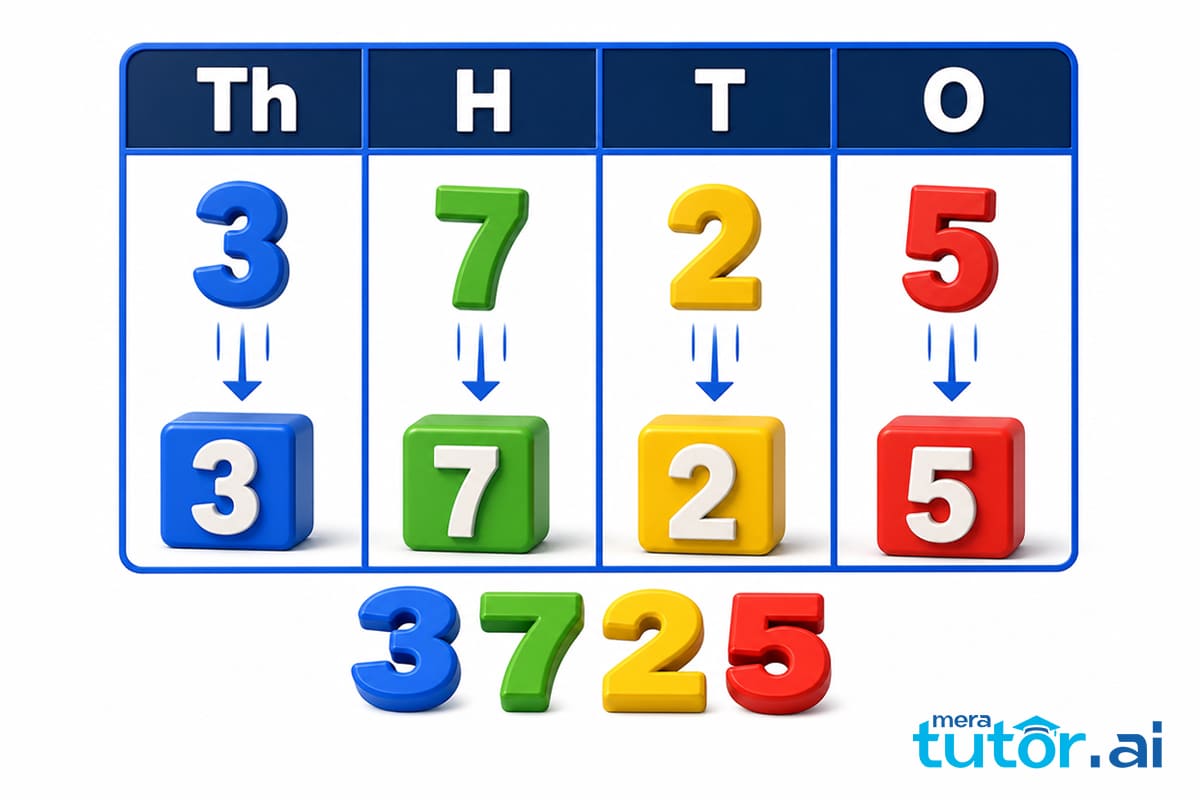
- Understanding the place value chart: Thousands (Th), Hundreds (H), Tens (T), and Ones (O)
- Writing numbers in expanded form
- Forming the largest and smallest numbers from a given set of digits
- Comparing and ordering numbers using the place value chart
- Applying big numbers to real-life situations, like counting donations or attendance at an event
Why a Good Thousands Around Us Class 4 Worksheet Matters
Chapter 4 is the foundation for every big-number topic that follows in Class 5 and beyond, so a shaky grasp here tends to resurface later as confusion with five- and six-digit numbers. A focused thousands around us class 4 worksheet gives children repeated, low-pressure practice with the exact skills their exams test: reading numbers aloud, writing them correctly, and comparing two four-digit numbers digit by digit. Regular practice with a well-designed worksheet also builds the number sense children will need for lakhs and crores later on, so it is worth treating this chapter as more than a one-week topic.
Key Concepts Covered in a Thousands Around Us Class 4 Worksheet
Most CBSE-aligned worksheets on this chapter test four skills, and each deserves its own practice block on a thousands around us class 4 worksheet.
Place value chart (Th, H, T, O): Every digit in a four-digit number has a place — thousands, hundreds, tens, or ones — and its value changes depending on where it sits. For example, in 3,102, the 3 is worth three thousand, not just three.
Expanded form: A number like 7,024 is broken down as 7,000 + 0 + 20 + 4, which helps children see why each digit matters.
Number names: Children learn to read and write numbers like 9,043 as “nine thousand forty-three,” matching how the number sounds to how it’s written.
Comparing and ordering: To compare two four-digit numbers, start from the leftmost digit (thousands) and move right only when digits are equal — a rule most thousands around us class 4 worksheet exercises test directly.
How Thousands Around Us Fits into the CBSE Class 4 Syllabus
Thousands Around Us sits early in the Class 4 Maths Mela textbook, right after chapters on shapes and measurement, which means most schools introduce it within the first two terms of the academic year. Because place value carries forward into every later chapter involving money, measurement conversions, and word problems, teachers typically weight it heavily in unit tests — so a child who is confident with a thousands around us class 4 worksheet tends to find the rest of the term’s number work noticeably easier. Parents helping at home don’t need to reteach the whole textbook; reviewing one thousands around us class 4 worksheet a week, alongside the solved examples below, is usually enough to keep pace with the classroom schedule.
Solved Example Questions from Thousands Around Us (With Answers)
These original practice questions mirror the style of a typical thousands around us class 4 worksheet, so your child can try them before moving to a full printable set.
Example 1: Compare 3,102 and 3,120 using < or >.
Answer: Both numbers share the same thousands digit (3) and hundreds digit (1). At the tens place, 3,102 has 0 and 3,120 has 2. Since 2 is greater than 0, 3,102 < 3,120.
Example 2: Write the expanded form of 4,856.
Answer: 4,856 = 4,000 + 800 + 50 + 6.
Example 3: Arrange 5,678, 5,687, and 5,768 in ascending order.
Answer: 5,678 < 5,687 < 5,768. The thousands and hundreds digits are the same for the first two numbers, so the tens digit decides the order, and the hundreds digit separates 5,768 from the rest.
Example 4: Write the number name of 9,043.
Answer: Nine thousand forty-three. Notice the zero in the hundreds place is silent — it is not read aloud but still holds its place in the number.
Work through all four examples again without looking at the answers, then check accuracy — this simple repeat-and-check habit is what makes a thousands around us class 4 worksheet effective rather than just busywork.

Common Mistakes Students Make in a Thousands Around Us Class 4 Worksheet
Most errors on a thousands around us class 4 worksheet fall into a handful of predictable patterns, so it helps to watch for these specifically:
- Misreading the comma position and confusing thousands with hundreds
- Forgetting that a zero in any place still holds that place (writing 4,856 as “four thousand fifty-six” and skipping the hundreds digit)
- Comparing numbers by “eyeballing” length instead of checking digit by digit from the left
- Making errors in expanded form by adding the wrong number of zeros to a digit
- Reversing digits when forming the largest or smallest number from a set
| Common Mistake | Correct Approach |
|---|---|
| Skipping the zero in a place (e.g. 4,856 read as “four thousand fifty-six”) | ✓ Every place is read, even when the digit is zero |
| Comparing numbers by length/appearance only | ✓ Compare digit-by-digit from the thousands place |
| Wrong number of zeros in expanded form | ✓ Match each digit’s zeros to its place value |
How to Practice Thousands Around Us at Home
Beyond a printed thousands around us class 4 worksheet, a few simple habits reinforce the chapter at home:
- Use physical objects like buttons, beads, or a place value slider to build numbers hands-on
- Point out big numbers in daily life — a stadium’s seating capacity, a book’s page count, a city’s distance in kilometres — and ask your child to read them aloud
- Practice writing the same number in three ways: digits, expanded form, and number name
- Time a short daily comparison drill: two four-digit numbers, greater-than or less-than, repeated until it becomes automatic
For structured, board-aligned repetition, MeraTutor.AI’s AI-powered worksheet generator can create fresh practice sets on demand and grade a child’s handwritten answers instantly, which is useful once the free worksheet below has been completed a few times.
Free Thousands Around Us Class 4 Worksheet — Download and Practice
You can download a free, printable thousands around us class 4 worksheet — with Easy, Medium, and Hard levels plus answer keys — from MeraTutor.AI’s Class 4 Maths worksheet library. Every worksheet is designed around the CBSE Maths Mela syllabus, so the question style matches what your child will see in class and in exams.

If your child has already tried a thousands around us class 4 worksheet on paper, MeraTutor.AI’s handwriting evaluation tool can scan the completed sheet and generate a detailed, instant feedback report — no waiting for the next school day. For children who need more guided, one-on-one support with place value, MeraTutor.AI also offers live online tutoring, alongside the core AI tutor features. You can compare plans on the pricing page, or start with the free AI tutor trial and sign up in a minute.
Ready to practice? Get your free worksheet.
Try FreeFrequently Asked Questions
1. What is the thousands around us class 4 worksheet chapter about?
It is Chapter 4 of CBSE Class 4 Maths (Maths Mela, new NCERT syllabus), and it teaches children to read, write, compare, and expand four-digit numbers from 1,000 to 9,999.
2. How do I compare two numbers on a thousands around us class 4 worksheet?
Start at the leftmost digit (thousands place) and compare digit by digit, moving right only when the digits are equal, until one number has a larger digit at some place.
3. What is the expanded form of a four-digit number?
It is the number written as the sum of the value of each digit — for example, 4,856 becomes 4,000 + 800 + 50 + 6.
4. Is a thousands around us class 4 worksheet the same as the old NCERT Math Magic Chapter 4?
No. Under the older Math Magic textbook, the equivalent Chapter 4 was called “Tick-Tick-Tick” and covered time, not place value — “Thousands Around Us” is specific to the newer Maths Mela syllabus.
5. Where can I get a free thousands around us class 4 worksheet with answers?
MeraTutor.AI’s free CBSE worksheet library includes Easy, Medium, and Hard printable sheets with answer keys for this chapter, along with AI grading for handwritten attempts.
6. How can I help my child avoid mistakes on this topic?
Practice comparing and writing numbers daily using real objects or a place value chart, and review a completed thousands around us class 4 worksheet together to catch recurring errors like silent zeros or comma confusion.
Disclaimer: This article is intended as general educational guidance for parents and students following the CBSE/NCERT curriculum. While it has been prepared with care and cross-checked against publicly available syllabus information, curricula, chapter names, and question patterns can change between academic years. Please verify the current syllabus and exam pattern with your child’s school or the official CBSE/NCERT resources, and use this content as a supplementary study aid rather than a substitute for classroom teaching.
