


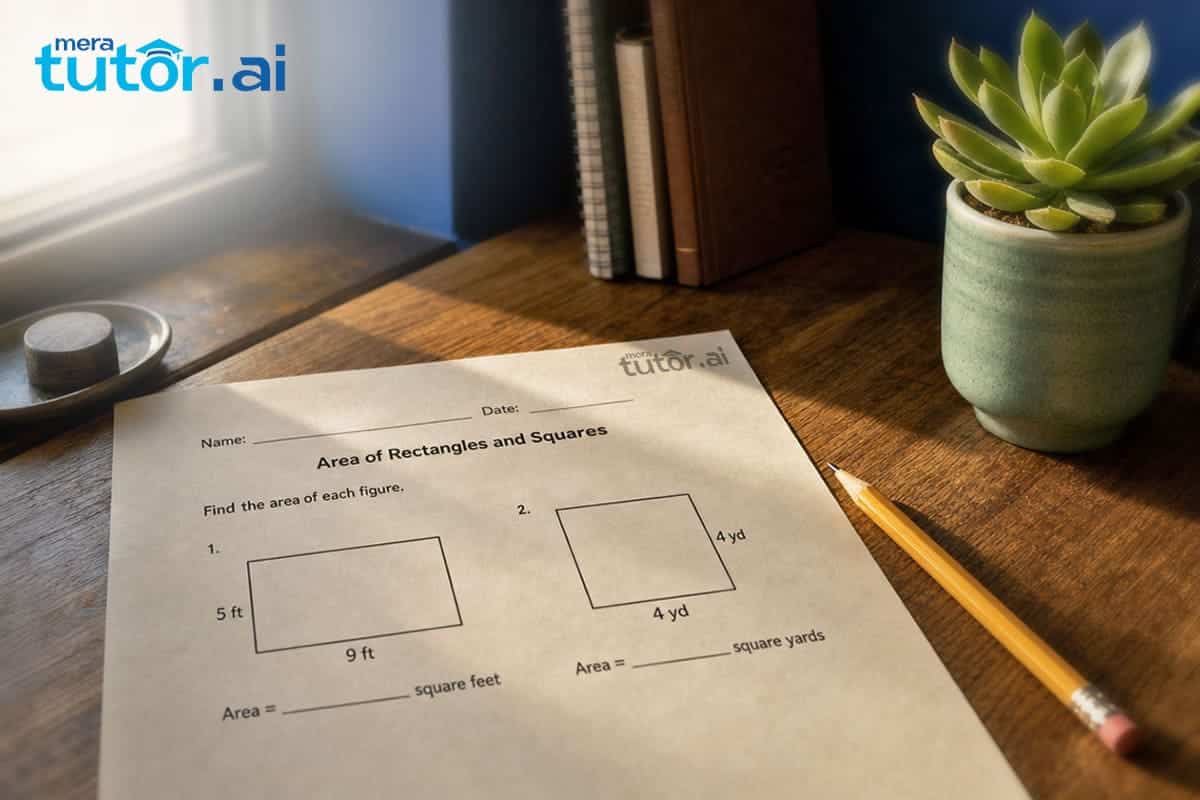
Table of Contents
Every Class 6 student meets Chapter 6 — Perimeter and Area — at the exact moment school maths starts feeling real. This perimeter and area class 6 worksheet with answers gives students a complete, CBSE-aligned practice set: clear definitions, the formulas that matter, 15 solved questions across three difficulty bands, the most common mistakes examiners see, and a free downloadable PDF from MeraTutor.AI so families can practise at home without hunting for reliable questions online.
What Is Perimeter and What Is Area?
Perimeter is the total distance around the boundary of a closed shape, measured in linear units like centimetres (cm) or metres (m). Area is the amount of surface enclosed inside that boundary, measured in square units like cm² or m². A simple way to remember the difference: perimeter is how much fence a garden needs, and area is how much grass grows inside it.
- Perimeter of a polygon = the sum of the lengths of all its sides.
- Area is measured by counting how many unit squares (1 unit × 1 unit) fit inside a shape.
- Perimeter is always a linear (1-D) measurement; area is always a square (2-D) measurement — mixing up the units is one of the most common marks lost in CBSE exams.
This distinction, drawn from Chapter 6 of the NCERT Ganita Prakash textbook, sits at the centre of the CBSE Class 6 Maths syllabus and forms the base for surface area and volume in Classes 7 and 8.
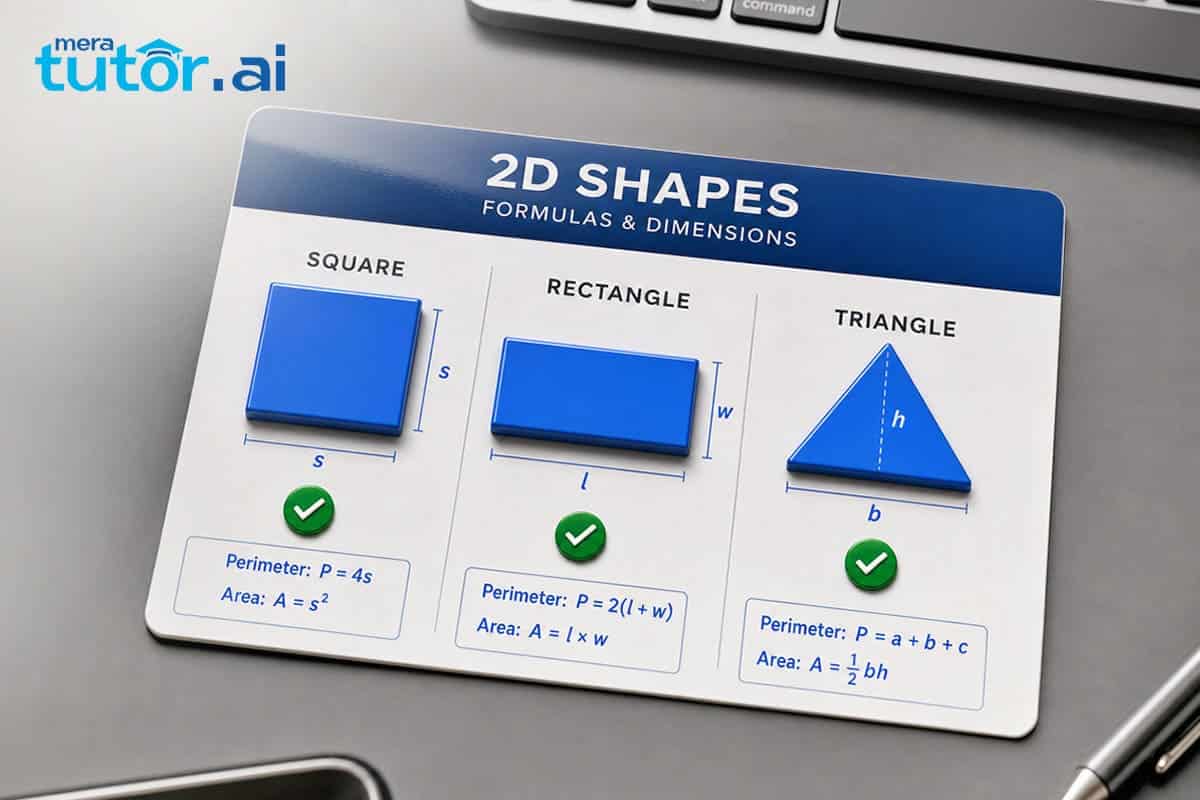
Perimeter and Area Formulas for Class 6 (Quick Reference)
Before attempting the perimeter and area class 6 worksheet below, it helps to have the core formulas in one place.
Perimeter and Area Class 6 Worksheet — 15 Practice Questions
These 15 questions follow the CBSE exam pattern, moving from direct formula recall to multi-step word problems, the same progression students see in this perimeter and area class 6 worksheet with answers.
Section A — Direct Formula Questions (1 Mark Each)
- Find the perimeter of a square with side 9 cm.
- Find the area of a rectangle with length 12 m and breadth 7 m.
- The perimeter of a regular hexagon is 48 cm. Find the length of each side.
- Find the perimeter of a triangle with sides 7 cm, 9 cm, and 12 cm.
- Find the area of a square piece of cardboard with side 6 cm.
Section B — Short Answer Questions (2 Marks Each)
- The perimeter of a rectangle is 82 cm. If the length is 30 cm, find its breadth.
- Find the perimeter of a rectangle with length 15 cm and width 10 cm.
- A wire bent into a rectangle of sides 5 cm and 3 cm is re-bent into a square. Find the side of the square.
- Find the area of a triangle with base 10 cm and height 6 cm.
- A rectangular hall is 20 m long and 10 m wide. Find its area and perimeter.
Section C — Word Problems (3 Marks Each)
- A rectangular garden is 30 m long and 15 m wide. How much fencing is needed to enclose it?
- The floor of a rectangular hall measures 20 m × 18 m. Find the cost of carpeting it at ₹10 per sq m.
- A triangle’s perimeter is 55 cm; two of its sides are 20 cm and 14 cm. Find the third side.
- A square park has a side of 40 m. Shawn runs 4 rounds of the park. Find the total distance covered.
- Find the cost of fencing a rectangular park 150 m long and 120 m wide, at ₹40 per metre.
Answer Key with Step-by-Step Working
Students who check their working against a step-by-step answer key build the self-correction habit that prevents avoidable mark deductions in CBSE exams.
Real-Life Examples of Perimeter and Area (India Context)
- Fencing a field: a farmer fencing a 150 m × 120 m plot needs 2 × (150 + 120) = 540 m of fencing; multiplying by the rate per metre gives the total cost.
- Flooring a room: estimating tiles needed means calculating the room’s area, then dividing by the area of one tile.
- Carpeting a hall: a 20 m × 18 m hall has an area of 360 m²; at ₹10 per sq m, the total carpet cost is ₹3,600.
- Comparing running tracks: a square field of side 58 m has a perimeter of 232 m, while a rectangular field of 170 m × 120 m has a perimeter of 580 m — useful for comparing distances covered per lap.
Common Mistakes Class 6 Students Make (And How to Avoid Them)
- Mixing up units — writing cm instead of cm² for area, or vice versa.
- Using the wrong formula — calculating area when perimeter was asked, or confusing l × b with 2(l + b).
- Confusing a side with the diagonal, and using the wrong length in a formula.
- Reading word problems too quickly and missing which value is actually being asked for.
- Skipping intermediate steps, which makes it impossible to self-diagnose an error.
A reliable fix: write the formula first, substitute the values, calculate, then state the answer with its correct unit — every time, for every question.
How to Download the Free Perimeter and Area Class 6 Worksheet PDF

Free, CBSE-aligned worksheets for this chapter are available as printable PDFs with full answer keys from MeraTutor.AI’s worksheet library and its dedicated Class 6 Perimeter and Area page.
- Visit the worksheet page and select Class 6 → Maths → Perimeter and Area.
- Choose a difficulty level: Easy, Medium, or Hard.
- Download the PDF, which includes the full answer key.
- Complete it on paper, then upload a photo for instant AI grading and feedback.
Turn Worksheet Practice Into Mastery With AI-Powered Grading
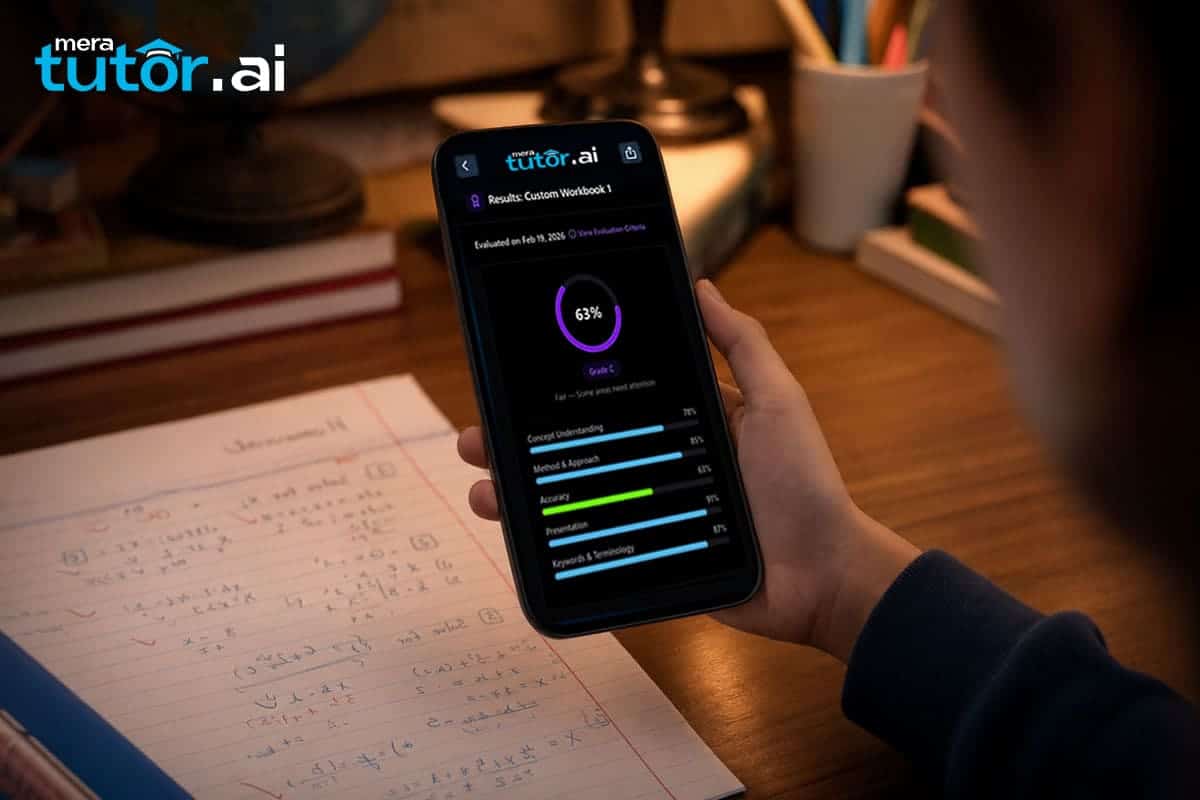
Pairing a static PDF with AI evaluation is what turns practice into real mastery. MeraTutor.AI’s handwriting evaluation feature reads a photographed worksheet, marks each answer, and classifies mistakes as Conceptual, Procedural, Arithmetic, or Carelessness — all in under 60 seconds. Coach Mode then uses Socratic questioning to guide the student to the correct approach instead of simply revealing the answer, and a parent dashboard shows exactly which topics are Weak, Developing, or Strong. To see the complete feature set, visit the MeraTutor.AI features page, or explore live online tutoring for students who need a guided walkthrough of this chapter. MeraTutor.AI supports over 50,000 students across CBSE, ICSE, State Board, and IB curricula.
Want AI to check your child’s worksheet in seconds?
Try MeraTutor.AI Free →Frequently Asked Questions
1. What is a perimeter and area class 6 worksheet used for?
A perimeter and area class 6 worksheet gives students structured, CBSE-aligned practice on finding the boundary length and enclosed surface of shapes like squares, rectangles, and triangles, matching the NCERT Ganita Prakash Chapter 6 syllabus.
2. What is the difference between perimeter and area for Class 6?
Perimeter is the total boundary length of a shape, measured in linear units like cm or m. Area is the surface enclosed within that boundary, measured in square units like cm² or m².
3. What are the key perimeter and area formulas for Class 6?
Perimeter of a square = 4 × side; area of a square = side × side; perimeter of a rectangle = 2 × (length + breadth); area of a rectangle = length × breadth; perimeter of a triangle = sum of its three sides; area of a triangle = ½ × base × height.
4. Is this worksheet aligned with the CBSE Class 6 syllabus?
Yes. The questions follow Chapter 6 of the NCERT Ganita Prakash textbook and the official CBSE Class 6 Maths syllabus for 2025–26.
5. How can I download the perimeter and area class 6 worksheet PDF for free?
Visit MeraTutor.AI’s free worksheets library, select Class 6 Maths, choose Easy, Medium, or Hard difficulty, and download the PDF with its complete answer key at no cost.
Conclusion
Perimeter and Area is one of the most practical chapters in Class 6 Maths, it shows up the moment a family fences a garden, tiles a floor, or works out a carpet’s cost. The most reliable path to full marks is consistent worksheet practice paired with a careful, step-by-step review of every answer, for both direct formula questions and word problems. Start with the 15 questions above, check them against the answer key, then download further practice from the MeraTutor.AI free worksheets library for Easy, Medium, and Hard levels across Classes 2–10.
