


Table of Contents
Shapes Around Us is Chapter 1 of the NCERT Class 4 Maths book (Maths Mela), and it is your child’s very first formal introduction to geometry. Instead of jumping into formulas, the chapter asks children to look around them — at a football, a matchbox, a birthday cap, a window — and notice the shapes hiding in everyday objects. If you are searching for a shapes around us class 4 worksheet to reinforce this chapter, this guide walks through every concept the NCERT syllabus covers, gives step-by-step solved examples, and ends with a printable practice set organised by difficulty.
In this guide, you’ll learn what Chapter 1 covers, where students usually go wrong, solved examples in the exact style NCERT uses, and a simple 7-day plan you can follow in 15–20 minutes a day.
Chapter Snapshot – What NCERT Covers in Shapes Around Us Class 4 Worksheet
Chapter 1, Shapes Around Us, opens the Class 4 Maths Mela textbook by training children to observe the world through the lens of geometry. It covers 2D shapes (flat shapes like circles, squares, and triangles) and 3D shapes (solid shapes like cubes, cones, and spheres), the idea of faces, edges, and vertices, how a 3D shape can be unfolded into a flat net, and how shapes combine into simple models and structures.
What You Will Learn (Learning Outcomes)
- Identify and name common 2D shapes (circle, square, rectangle, triangle, oval) and 3D shapes (cube, cuboid, cone, cylinder, sphere)
- Tell the difference between a flat (2D) shape and a solid (3D) shape
- Count and describe the faces, edges, and vertices of common 3D shapes
- Recognise the net of a simple solid and match it to the correct 3D shape
- Sort shapes by properties — for example, shapes with curved faces versus shapes with only flat faces
- Build a simple model using basic shapes and explain which shape was used for which part
What Students Usually Find Difficult
Faces, edges, and vertices — mixing up the terms. Children often confuse an edge (a line where two faces meet) with a vertex (a corner point). The fix that works best is counting on a real object — a matchbox or a Rubik’s cube — while saying each word out loud.
Nets that don’t “look like” the shape at first glance. A flattened cube net can look confusing until a child physically folds a paper cutout. Encourage hands-on folding rather than only looking at pictures.
Curved vs flat faces. Many students assume anything round is automatically the same category — but a cylinder has both a curved face and two flat circular faces, which trips up quick sorting.
How NCERT Typically Asks Questions in Chapter 1
- Naming/identifying: “Name the 2D shapes you see in this picture.”
- Counting: “How many faces, edges, and vertices does a cube have?”
- Matching: “Match each net to the 3D shape it forms.”
- Sorting/classifying: “Sort these shapes into curved-face and flat-face groups.”
- Model-building/reasoning: “What shapes did you use to build your model, and why?”
What Are Shapes Around Us? (2D and 3D Shapes Explained)
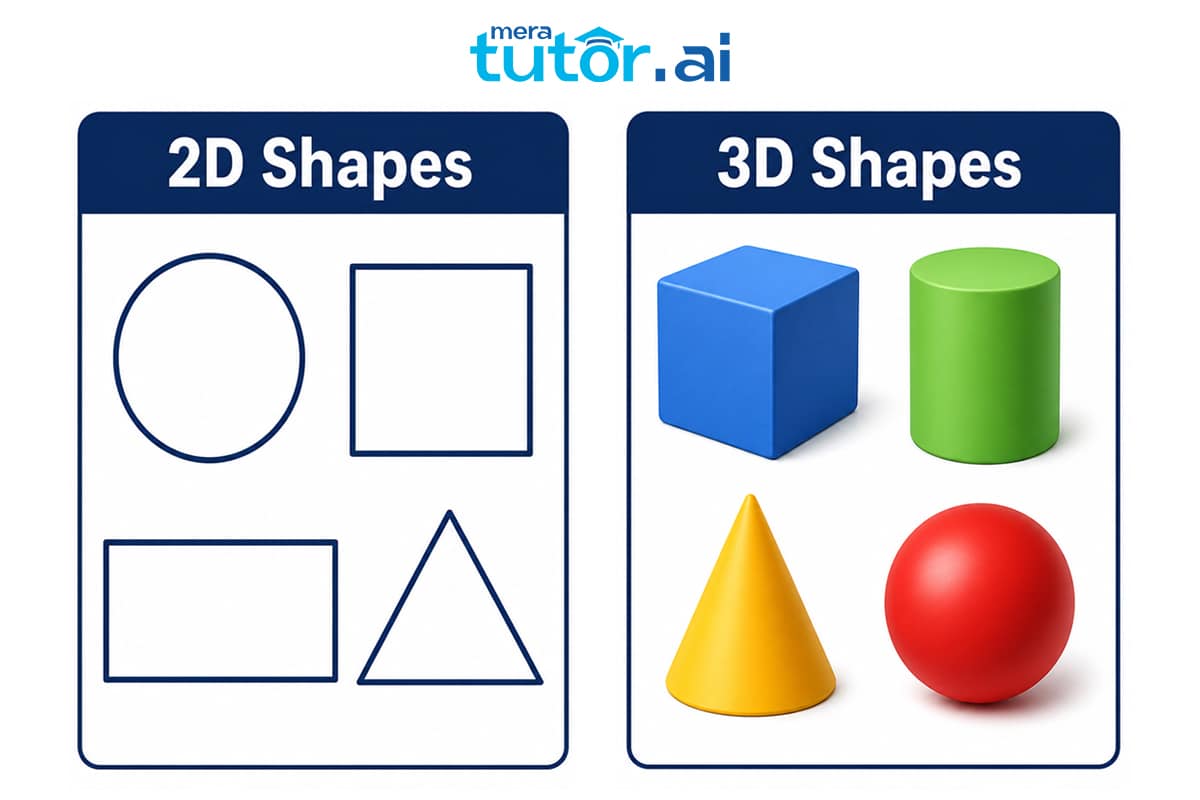
2D shapes are flat shapes that have length and width but no thickness. The common ones in this chapter are the circle, square, rectangle, triangle, and oval. You’ll find them on a clock face, a window pane, a slice of pizza, and a door.
3D shapes (also called solid shapes) have length, width, and height. The chapter focuses on the cube, cuboid, cone, cylinder, and sphere. A dice is a cube, a matchbox is a cuboid, an ice-cream cone is a cone, a water bottle is close to a cylinder, and a football is a sphere.
Quick way to tell them apart: if you can draw it on paper and it stays flat, it’s 2D. If you need to hold it and it takes up space, it’s 3D.
Faces, Edges, and Vertices — The Building Blocks of 3D Shapes
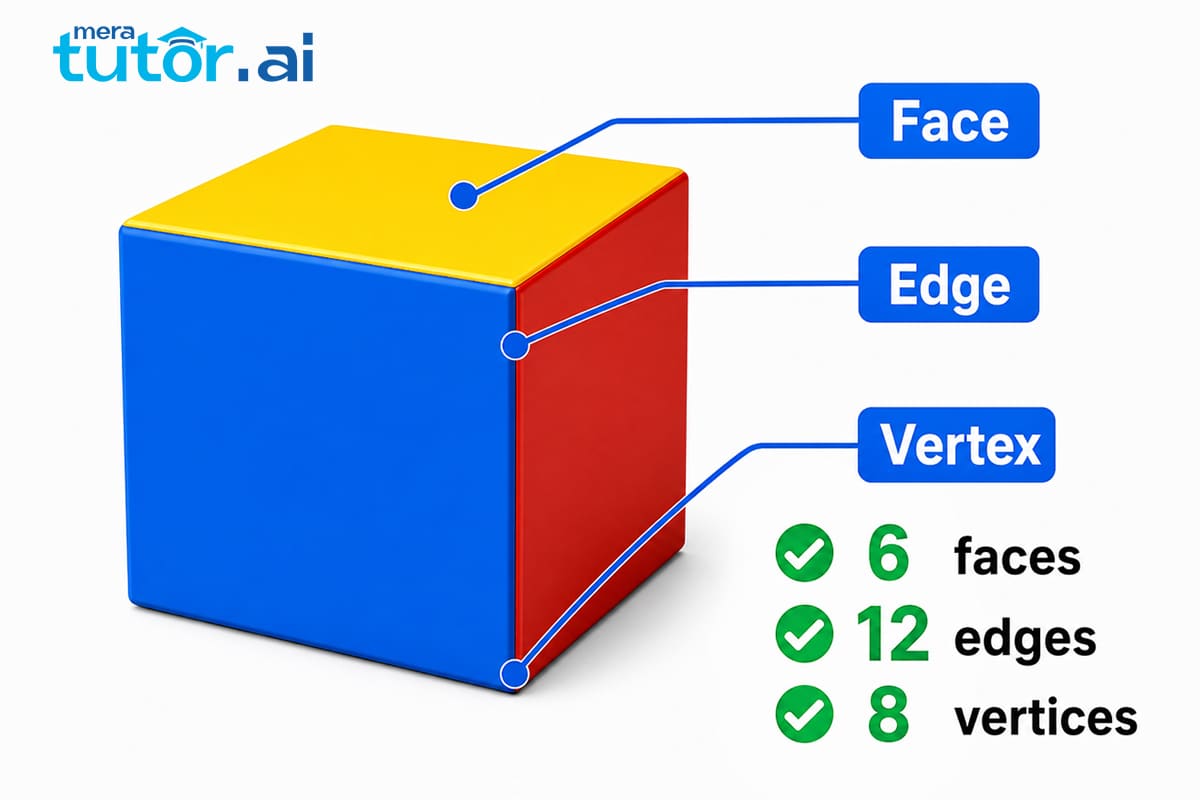
- A face is any flat (or curved) surface of a 3D shape.
- An edge is the line where two faces meet.
- A vertex (plural: vertices) is the point where edges meet — a corner.
| 3D Shape | Faces | Edges | Vertices | Curved Face? |
|---|---|---|---|---|
| Cube | 6 | 12 | 8 | No |
| Cuboid | 6 | 12 | 8 | No |
| Cylinder | 2 flat + 1 curved | 2 | 0 | Yes ✓ |
| Cone | 1 flat + 1 curved | 1 | 1 | Yes ✓ |
| Sphere | 1 curved | 0 | 0 | Yes ✓ |
A cube has 6 faces, 12 edges, and 8 vertices — the numbers students are asked to recall most often in this chapter. A cylinder, by contrast, has 2 flat circular faces, 1 curved face, and no vertices at all, which is exactly why sorting by “curved vs flat” trips students up if they memorise numbers without understanding what each word means.
Nets of Solid Shapes — Folding and Unfolding 3D Objects
A net is what you get when you unfold a hollow 3D shape and lay it flat — like opening up an empty cereal box along its edges. If you fold the net back along the dotted lines, you get the solid shape again. This chapter usually shows the net of a cube or a cuboid and asks students to identify which solid it will form when folded.
Tip for parents: the fastest way to make this click is to actually cut open an empty box and let your child refold it. It turns an abstract diagram into something they’ve done with their own hands.
Sorting Shapes: Curved Faces vs Flat Faces
NCERT often asks students to sort a mixed group of shapes into two categories — those with only flat faces (like a cube or cuboid) and those with at least one curved face (like a cone, cylinder, or sphere). A simple approach that works well:
- Run a finger along each face of the object.
- If the finger travels in a straight line, that face is flat.
- If the finger curves without a sharp corner, that face is curved.
- A shape with even one curved face goes in the “curved” group.
Building Models with Shapes (Real-Life Application)
A recurring activity in this chapter asks children to build a small model — like a building or a monument — using blocks, and then explain which shapes they used for which part (for example, cuboids for pillars, a cone for a roof, cylinders for towers). This is where the chapter connects geometry to the real world: it shows children that architecture and everyday design are really just shapes working together.
Solved Examples (Chapter 1 Style, Step-by-Step)
Example 1: Identifying 2D vs 3D shapes
Question: Sort the following into 2D and 3D shapes — circle, cube, triangle, cylinder, square, sphere.
Step 1: Ask — does it have thickness, or is it flat?
Answer: 2D shapes → circle, triangle, square. 3D shapes → cube, cylinder, sphere.
Example 2: Counting faces, edges, and vertices
Question: How many faces, edges, and vertices does a cuboid (like a matchbox) have?
Step 1: Count the flat surfaces → 6 faces (like a cube, but rectangular).
Step 2: Count the lines where faces meet → 12 edges.
Step 3: Count the corner points → 8 vertices.
Answer: A cuboid has 6 faces, 12 edges, and 8 vertices — the same counts as a cube, just with rectangular faces instead of square ones.
Example 3: Matching a net to its shape
Question: A flattened shape shows 6 identical squares arranged in a cross pattern. What 3D shape will it form when folded?
Step 1: Count the squares → 6 identical squares.
Step 2: Recall which solid has 6 identical square faces → a cube.
Answer: The net will fold into a cube.
Example 4: Curved vs flat sorting
Question: Does a cone have any flat faces? Does it have a vertex?
Step 1: A cone has 1 flat circular face (the base) and 1 curved face.
Step 2: The pointed tip where the curved surface meets is a vertex.
Answer: Yes — a cone has 1 flat face, 1 curved face, and 1 vertex (the tip).
Practice Questions (3 Levels) — Chapter 1 Readiness Builder
Level 1 (Easy): Build Confidence
- 1) Name three 2D shapes you can see in your classroom.
- 2) Name three 3D shapes you can see in your kitchen.
- 3) How many faces does a cube have?
- 4) Is a football a 2D shape or a 3D shape?
- 5) Sort into 2D or 3D: rectangle, sphere, triangle, cone.
Level 2 (Medium): Exam-Like Practice
- 6) A cuboid has how many faces, edges, and vertices?
- 7) Name one object shaped like a cylinder and one shaped like a cone.
- 8) Does a sphere have any edges or vertices? Explain why or why not.
- 9) A net has 6 identical square faces. Which 3D shape will it form?
- 10) Sort these into curved-face and flat-face groups: cube, sphere, cuboid, cylinder, cone.
Level 3 (Hard/HOTS): Pattern Traps
- 11) Two shapes both have 1 curved face — one has a vertex and one does not. Name both shapes and explain the difference.
- 12) You are building a model of a house using blocks. Which 3D shapes would you use for the walls, the roof, and a chimney? Explain your choice.
- 13) A shape has 2 flat circular faces and 1 curved face, but no vertices. Which shape is it?
- 14) Explain in your own words why a cuboid and a cube both have 6 faces, 12 edges, and 8 vertices even though they look different.
- 15) Draw the net of a cuboid (a matchbox shape) and label how many rectangles it will need.
Quick Self-Check (Before You Look at Answers)
- Did I check whether the shape is flat (2D) or solid (3D) first?
- Did I count faces, edges, and vertices carefully instead of guessing from memory?
- Did I check for curved faces before deciding a shape has “no vertices”?

Common Mistakes in Chapter 1 (and How to Fix Them)
Mistake 1: Confusing faces, edges, and vertices
What happens: A child says a cube has “8 faces” because they’re thinking of the corners instead.
Fix: Physically point to a real cube-shaped object (a dice or a box) and touch a face, then an edge, then a vertex, saying the word each time. Repetition on a real object beats memorising numbers.
Mistake 2: Assuming all round shapes belong together
What happens: A child groups a sphere and a cylinder together as “the same kind of round shape.”
Fix: Ask whether the shape has any flat face at all. A sphere has none; a cylinder has two. That single question resolves most curved-vs-flat mix-ups.
Mistake 3: Struggling to “see” a net as a folded shape
What happens: The net looks like an unrelated flat pattern, so the child guesses the answer instead of reasoning it out.
Fix: Cut and fold an actual paper net. Once a child has folded one net by hand, reading net diagrams on paper becomes far easier.
Mini Checklist (Use Before Final Answer)
- Did I decide 2D or 3D first?
- Did I count faces, edges, and vertices on the real object, not just from memory?
- Did I check for curved faces before finalising the sort?
Why Chapter 1 Matters for the Rest of Class 4 Mathematics
Shapes Around Us is placed first in the NCERT Class 4 Maths book because it builds the observation habits geometry relies on for the rest of the year — and beyond. Here’s how it quietly supports what comes later:
- It trains children to describe what they see precisely, which helps in every later geometry and measurement chapter.
- Understanding faces, edges, and vertices now makes perimeter, area, and volume concepts in higher classes far less abstract.
- Working with nets builds spatial reasoning — the same skill used later for symmetry and 3D visualisation.
- Sorting and classifying shapes strengthens the logical-reasoning skills tested throughout CBSE maths, not just in geometry.
Bottom line: a child who is genuinely comfortable naming shapes, counting their parts, and reasoning about nets in Class 4 will find every later geometry chapter easier.
Study Smarter with MeraTutor.AI
Chapter 1 rewards hands-on practice more than memorisation. Here’s how MeraTutor.AI can help your child practise this chapter with less stress and better results:
- Use the AI Tutor to explain a confusing term (like the difference between an edge and a vertex) in simple, Class 4-friendly language, with one extra example of the same type.
Practise with structured, difficulty-ordered worksheets instead of random questions — the Shapes Around Us worksheet set moves from Easy to Hard so your child builds confidence before tackling exam-style questions.
Upload your child’s handwritten worksheet answers and let the AI grade them instantly, showing exactly which shape-counting or naming mistakes to fix — see the Smart Workbook feature for details.
Conclusion
Shapes Around Us is Class 4’s gentle first step into geometry — and it sticks best when it’s learned by touching, folding, and sorting real objects, not just reading definitions. Spend 15–20 minutes a day for a week: one day on 2D vs 3D, one day on faces/edges/vertices, one day on nets, one day on sorting, one day on model-building, and two days mixing all of it into practice questions. By day seven, most Class 4 students are confidently answering every question style NCERT asks in this chapter.
FAQs
1. What is Shapes Around Us in Class 4 Maths?
It’s Chapter 1 of the NCERT Class 4 Maths Mela textbook. It teaches children to identify 2D and 3D shapes, count faces, edges, and vertices, understand nets of solid shapes, and build simple models using shapes.
2. What is the difference between a 2D shape and a 3D shape?
A 2D shape is flat and has only length and width — like a circle or square. A 3D shape is solid and has length, width, and height — like a cube or sphere.
3. How many faces, edges, and vertices does a cube have?
A cube has 6 faces, 12 edges, and 8 vertices. A cuboid (like a matchbox) has the same counts, just with rectangular faces instead of square ones.
4. What is a net in Class 4 Maths?
A net is a flat, unfolded pattern that forms a 3D shape when folded along its lines — like unfolding an empty box to see how it opens flat, and refolding it back into the box shape.
5. Where can I download a free Shapes Around Us Class 4 worksheet?
You can download free, difficulty-wise printable PDFs from the Shapes Around Us Class 4 worksheet page on MeraTutor.AI, with Easy, Medium, and Hard levels and answer keys included.
6. How much time should my child practise this chapter daily?
15–20 minutes a day for about a week is usually enough to move from recognising shapes to confidently answering exam-style questions on faces, edges, vertices, and nets.
Download Chapter 1 Worksheets and Practice by Difficulty
Download the Chapter 1 (Shapes Around Us) worksheet set and practise in a way that actually builds confidence. The worksheets are organised by difficulty — Easy, Medium, and Hard — so your child can start simple and work up to exam-style questions, with answer keys included for every level.
Ready to practise Shapes Around Us with your child?
Try Free — Sign Up